 Menu
Menu
Menu
Menu

The best coffee table for most living rooms in 2026 is one that sits 2-4 cm (¾-1½ in) below sofa cushion height (typically 40-45 cm (16-18 in) tall), extends to roughly two-thirds the length of your sofa, and uses a material – walnut, travertine, or stainless steel – matched to the room’s existing palette and daily use. For small spaces, a coffee table with storage adds hidden functionality without visual clutter. For families with children or pets, edge profile and material resilience matter more than aesthetics alone. For anyone planning to keep their furniture for decades rather than seasons, a bespoke coffee table offers proportions, materials and craft that no ready-made equivalent can match.
The right coffee table for your living room depends on three things: your sofa’s proportions, your room’s traffic flow, and how you use the space day to day. Getting those three factors right before looking at designs saves you from the most common mistake in living room furniture – buying something that looks correct in isolation but feels wrong in the room.
Your sofa determines the non-negotiable parameters for your coffee table decision before aesthetics enter the picture at all. A table that is too large overwhelms the seating arrangement; one that is too small floats awkwardly in front of a generously sized sectional. Measure your sofa’s length and note the cushion height from the floor – those two numbers are your constraints before anything else is considered.
Most designers, as illustrated in Dezeen’s lookbook of contemporary living rooms with sculptural coffee tables, recommend working from the sofa outward rather than from the room inward. The sofa is the anchor; the living room table is its functional complement.
A coffee table used primarily for drinks, a laptop and a television remote needs a different specification than one chosen as a sculptural focal point. If you eat off yours regularly, prioritise a surface height of 45-50 cm (18-20 in) and a material that cleans easily – sealed stone or powder-coated steel rather than open-grain timber. If the table is primarily decorative, a sculptural piece in travertine or burl wood becomes the stronger long-term investment.
Households with young children should prioritise rounded edges and sealed surfaces above all other criteria. Those that entertain frequently benefit from coffee tables with storage, which allow the surface to be cleared in a single movement before guests arrive.
Choosing between a ready-made and a bespoke coffee table at the start of the process saves significant time and prevents a compromise you will notice every single day. Most standard coffee tables are manufactured in a limited range of dimensions that assume a 220-240 cm (87-94 in) sofa and a standard room configuration. If your sofa is shorter, wider, lower, or positioned at an unusual angle, a ready-made table is unlikely to sit in correct proportion to the space.
A ready-made table works well when your room layout is standard, your timeline is short, and your budget sits below €800 ($875). Solid mid-range options in walnut veneer over hardwood cores, powder-coated steel and engineered stone tops exist at this level and represent good value for their category.
A custom coffee table becomes the right choice when your sofa has an unusual length, your room’s proportions call for a specific visual weight, or you want a material combination – solid walnut with a travertine top, burl wood with brushed steel legs – that no ready-made manufacturer offers. It also makes sense when you plan to keep the piece for 20 years or more. Read the full case for made-to-order in the guide to 10 benefits of choosing bespoke furniture – the quality and proportion arguments are difficult to argue against once you understand what custom manufacture actually involves.
A coffee table should sit 2-4 cm (¾-1½ in) below sofa cushion height – for most standard sofas, that means a coffee table height of 40-45 cm (16-18 in) – and extend to roughly two-thirds of the sofa’s total length. These two rules, applied together, produce a table that is in correct visual and functional proportion to the seating arrangement it serves.
The Livingetc’s coffee table size guide, which draws on advice from multiple interior designers, echoes both measurements as the standard baseline for well-proportioned seating arrangements, and they hold true across virtually every sofa style and room size.
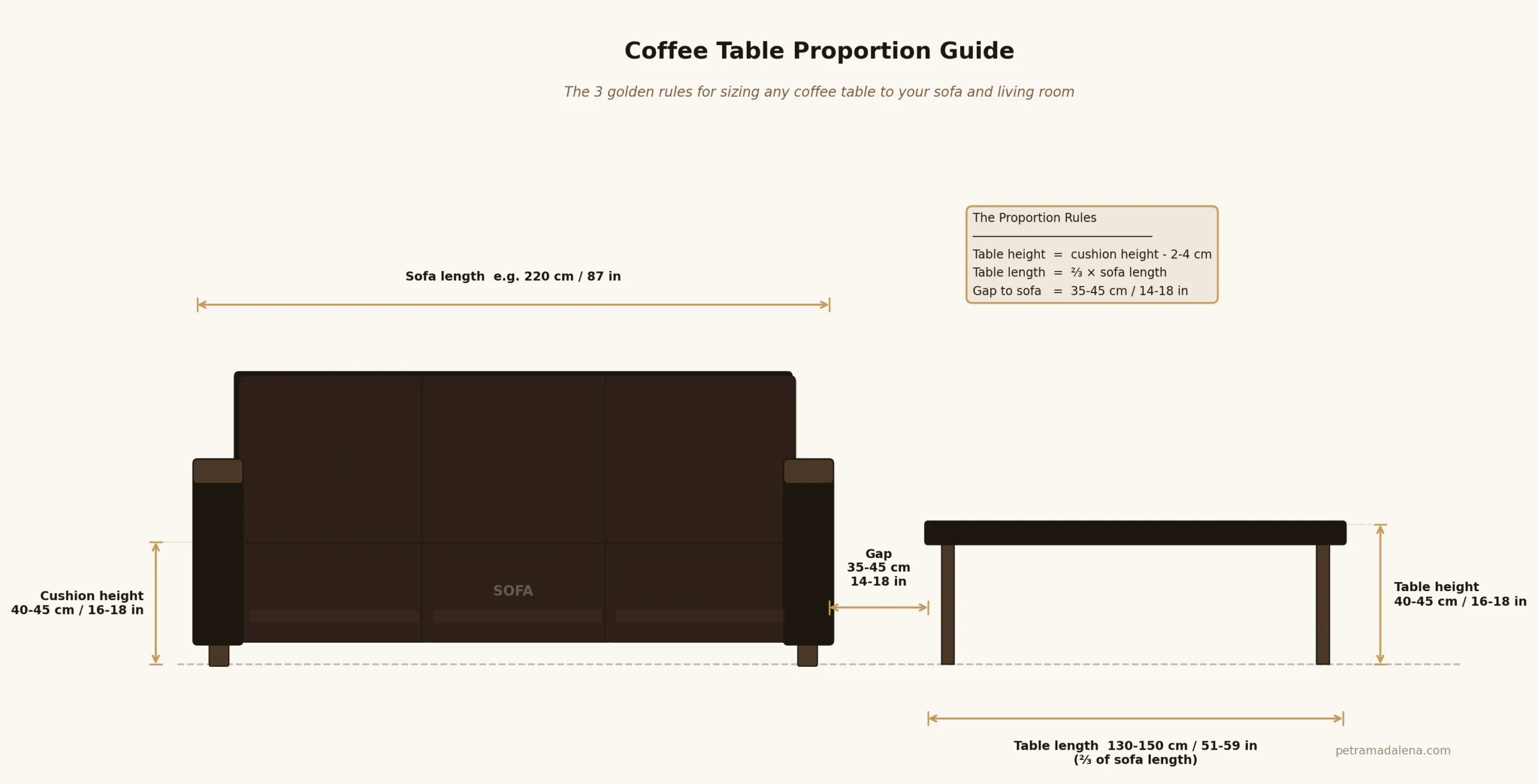
Coffee table height is the single most misunderstood specification in living room furniture. Most buyers default to a standard 45 cm (18 in) table regardless of sofa height – but a deep, low lounge sofa with 38 cm (15 in) cushions needs a table no taller than 36 cm (14 in), or reaching for a drink becomes genuinely uncomfortable. Measure from the floor to the top of your sofa cushion under full sitting weight and subtract 2-4 cm (¾-1½ in) for the correct target coffee table dimensions.
Higher sofas – those with firm, upright seats at 48-50 cm (19-20 in) – work better with taller tables in the 46-50 cm (18-20 in) range. Matching height to cushion level rather than using a universal standard is what separates a table that feels purposefully designed for the room from one that feels slightly off without you being able to identify why.
The ideal coffee table length is two-thirds of the sofa’s total length. For a 220 cm (87 in) sofa, target a table between 130-150 cm (51-59 in). For a 180 cm (71 in) sofa, the correct range is 110-125 cm (43-49 in). Going slightly longer than two-thirds is acceptable if the room’s floor plan supports it; going shorter than half the sofa’s length creates an unbalanced arrangement where the table appears to belong to a different seating configuration.
The correct distance between a sofa and a coffee table is 35-45 cm (14-18 in). At 35 cm (14 in), objects on the surface are within easy reach from a seated position without leaning forward. At 45 cm (18 in), there is comfortable clearance for anyone stepping around or behind the table. Beyond 50 cm (20 in), the table starts to feel disconnected from the seating – more like an independent piece than a functional part of the arrangement.
Coffee Table Dimensions at a Glance
| Sofa Length | Recommended Table Length | Ideal Height | Distance from Sofa |
|---|---|---|---|
| 160-180 cm (63-71 in) | 105-120 cm (41-47 in) | 38-42 cm (15-17 in) | 35-45 cm (14-18 in) |
| 180-220 cm (71-87 in) | 120-145 cm (47-57 in) | 40-45 cm (16-18 in) | 35-45 cm (14-18 in) |
| 220-260 cm (87-102 in) | 145-170 cm (57-67 in) | 42-47 cm (17-19 in) | 35-45 cm (14-18 in) |
| 260 cm+ (102 in+) | 170 cm+ (67 in+) or two nested tables | 44-48 cm (17-19 in) | 35-50 cm (14-20 in) |
Round and oval coffee tables are the best choice for sectional and L-shaped sofas because they allow unobstructed movement around all sides of the seating arrangement and eliminate sharp corners in high-traffic zones. Rectangular and square tables serve long, linear sofas and symmetrical seating layouts more effectively.
A round coffee table works naturally with a sectional sofa because it sits within the open curve of the seating arrangement and is visible – and accessible – from every seat without a corner blocking the way. For standard sectionals, aim for a diameter of 90-110 cm (35-43 in). Interior platform Crate & Barrel’s coffee table buying guide recommends round tables as the default shape for any sofa configuration where movement around the table matters.
An oval table offers the same safety and flow benefit as a round but with greater surface area – a useful compromise when a sectional is used regularly for entertaining and needs more practical surface space than a circle provides.
A rectangular coffee table suits a long, straight sofa best because both horizontal planes echo each other’s proportions. A 220 cm (87 in) sofa paired with a 140 cm (55 in) rectangular table creates a balanced, grounded visual rhythm. The flat parallel edges of both pieces signal that the room has been composed intentionally rather than assembled from unrelated parts.
Rectangular tables also offer the most usable surface area per footprint, making them the easier format for styling with books, a tray and decorative objects in a structured, zoned layout.
Square coffee tables work best in rooms where two identical sofas face each other, or where a large square sectional creates a defined central zone. A square table anchors the symmetry and produces a formal, composed quality in the arrangement. Avoid square tables in narrow rooms – they shorten the perceived length of the space and introduce a visual blockage that a rectangular table would not create.
In a small living room, a round or oval coffee table is nearly always the better choice. The absence of corners reduces the visual mass of the piece, and the smooth perimeter allows movement through tight spaces more comfortably than a table with sharp edges. For very small rooms under 20 m² (215 sq ft), a nested pair of smaller round tables provides flexible surface area that can be separated for entertaining and tucked together for everyday use.
Shape Selector Guide
| Room Type / Sofa Shape | Best Table Shape | Why | What to Avoid |
|---|---|---|---|
| L-shaped or sectional sofa | Round or oval | No corners, free movement from all sides | Large rectangular (blocks access) |
| Long straight sofa (180 cm+ / 71 in+) | Rectangular | Visual symmetry with sofa, more surface area | Square (often too wide for the room) |
| Paired sofas facing each other | Square or rectangular | Anchors the symmetry between the two pieces | Round (insufficient surface area) |
| Small room (under 20 m² / 215 sq ft) | Round or nested ovals | Reduces perceived mass, easier to move around | Large rectangular (dominates small floor plan) |
| Open-plan, floating arrangement | Oval | Defines the living zone without creating hard edges | Square corner (creates obstacle in open flow) |
Walnut and travertine dominate modern coffee table design in 2026 because both materials improve visually with age and complement a wide range of interior palettes without requiring a complete room rethink. Alongside these, burl wood, stainless steel, marble and glass each offer specific qualities that suit particular room types and lifestyles.
A walnut coffee table brings warmth, grain movement and structural honesty to a living room that no veneer or engineered timber can replicate over time. Solid walnut has a fine, close grain that responds to light differently across the day – richer in the morning under natural light, deeper and more amber under warm artificial light in the evening. It is one of those materials that rewards proximity: the closer you live with it, the more you appreciate it.
Maintenance is straightforward. Wipe with a dry or lightly damp cloth for daily cleaning and apply a light oil or wax once or twice a year to nourish the timber. Avoid standing water and prolonged direct sunlight to preserve the colour tone. A solid wood coffee table in walnut is one of the most durable surface options available – properly maintained, it should last two generations without structural compromise.
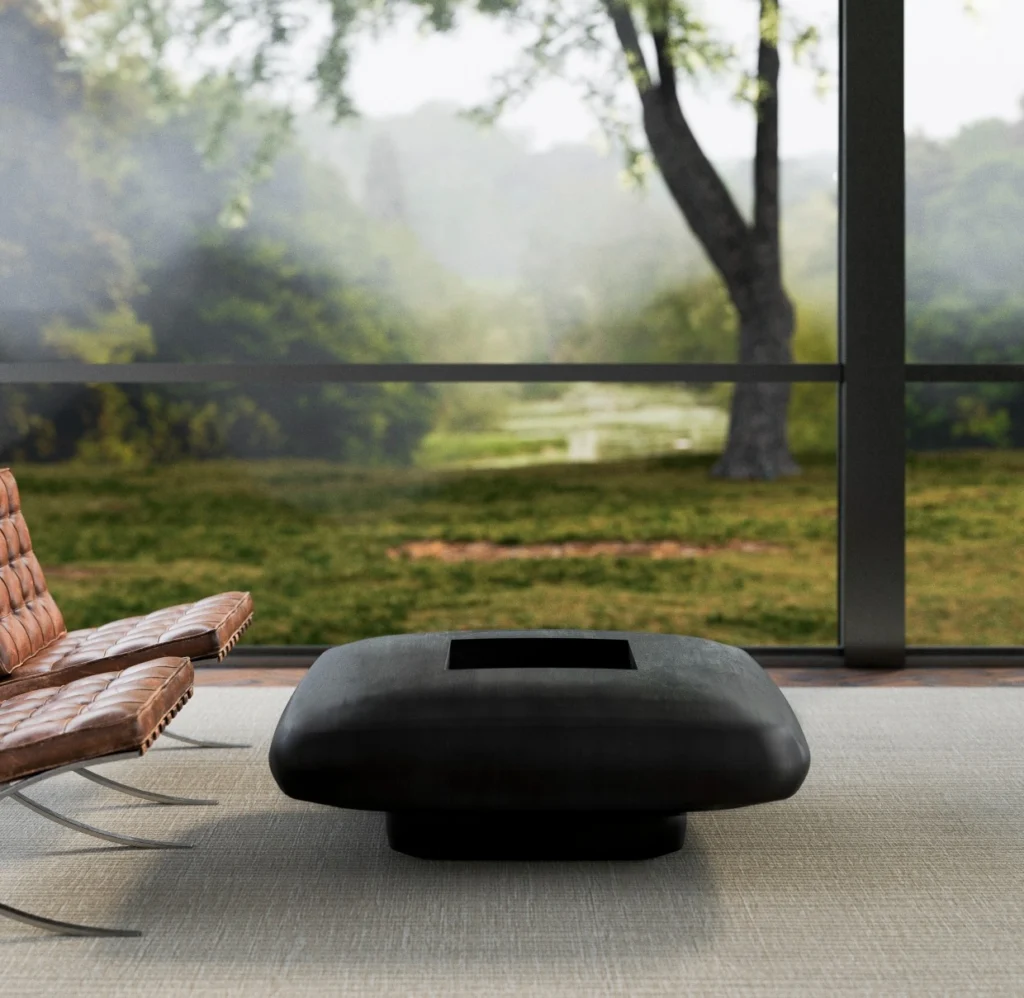
Carved from solid birch and finished in deep matte black, this table is a study in sculptural restraint. The rounded, pillow-like top and single cylindrical plinth base sit in deliberate tension with each other – monolithic from a distance, sensuous at close range. Every edge is deliberately soft, making it one of the rare designer coffee tables that is equally appropriate for rooms with children and for rooms that prioritise formal design above all else.
View Solid Birch Coffee Table →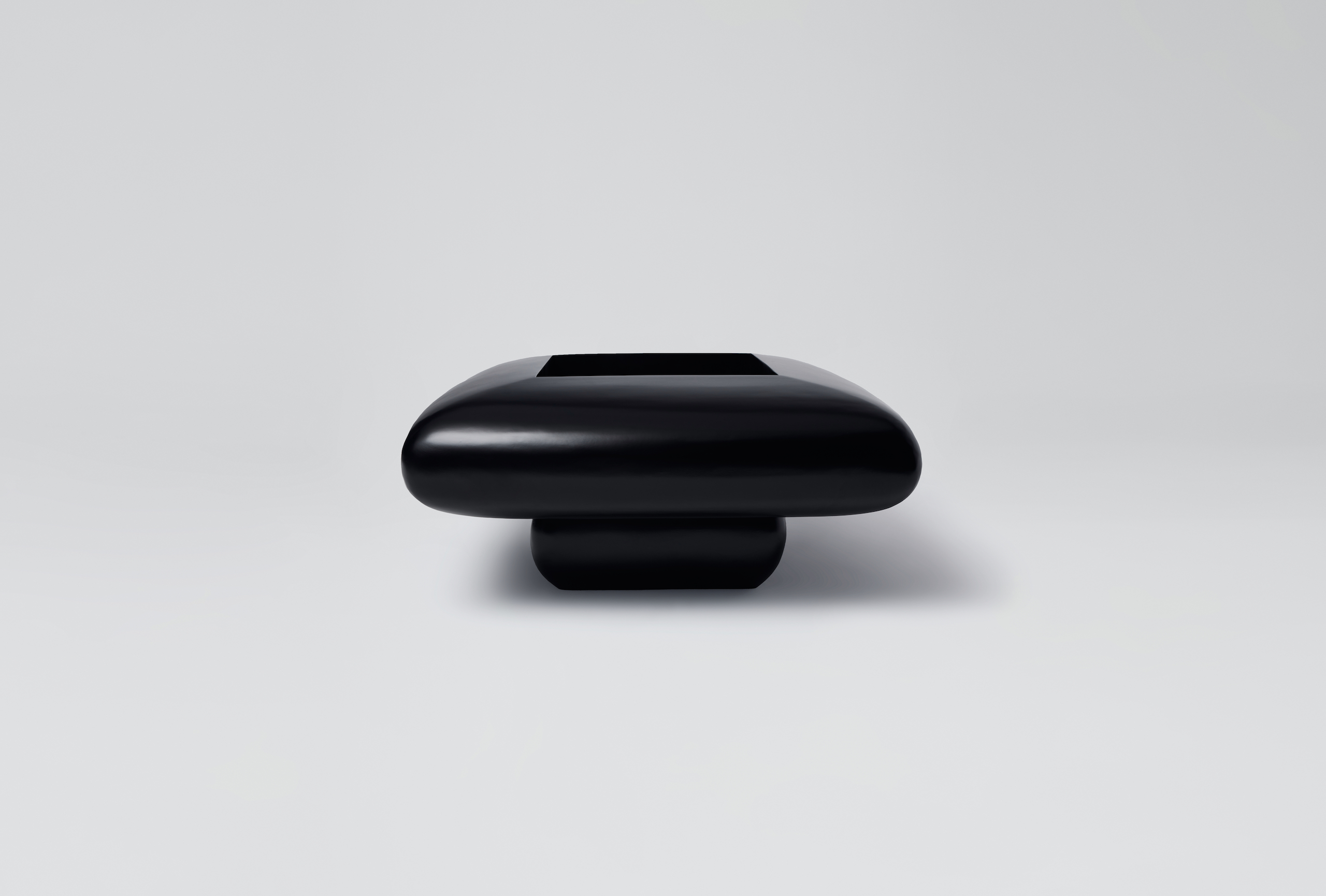
For guidance on sustainable walnut sourcing and responsible timber selection, the Petra Madalena Sustainable Bespoke Furniture Guide 2026 covers material provenance in useful detail.
A travertine coffee table introduces organic texture, visual weight and a sense of geological permanence that no manufactured surface can convincingly imitate. The characteristic pitting and veining of travertine means no two slabs are identical – a quality that makes a stone coffee table inherently unique even before any custom shaping is applied to it.
Travertine is heat-resistant and genuinely durable. Seal it once a year with a quality stone sealant to protect against liquid absorption and surface staining. Avoid abrasive cleaners and acidic products – citrus juice, wine and vinegar can etch the surface if left to sit. In exchange for this modest annual maintenance, travertine remains visually compelling for decades and improves rather than deteriorates with careful use.
Its mass commands a room in a way lighter materials simply do not. For guidance on pairing travertine with walnut and steel in the same living space, the guide to mixing stone, wood and metal in interior design is worth reading before making any final material decisions.
A burl coffee table is the most visually distinctive material choice available – each burl section is formed by unusual tree growth patterns that produce swirling, abstract grain impossible to replicate or predict. No two burl slabs share the same pattern, and no manufacturer can produce two identical pieces.
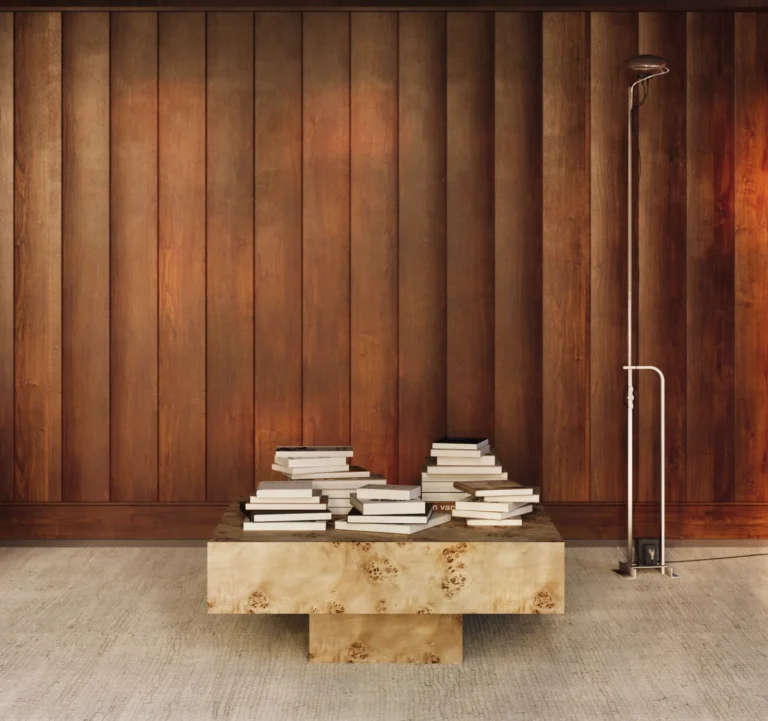
This burl coffee table is built from matched poplar burl panels in a solid block format – no legs, no base separation, just a single rectangular volume where the grain does everything. The swirling amber and brown figuring across each panel is completely unrepeatable, which means no two pieces share the same visual character. Placed in a neutral living room, the Poplar Burl reads less as furniture and more as a natural object that happens to function as a coffee table.
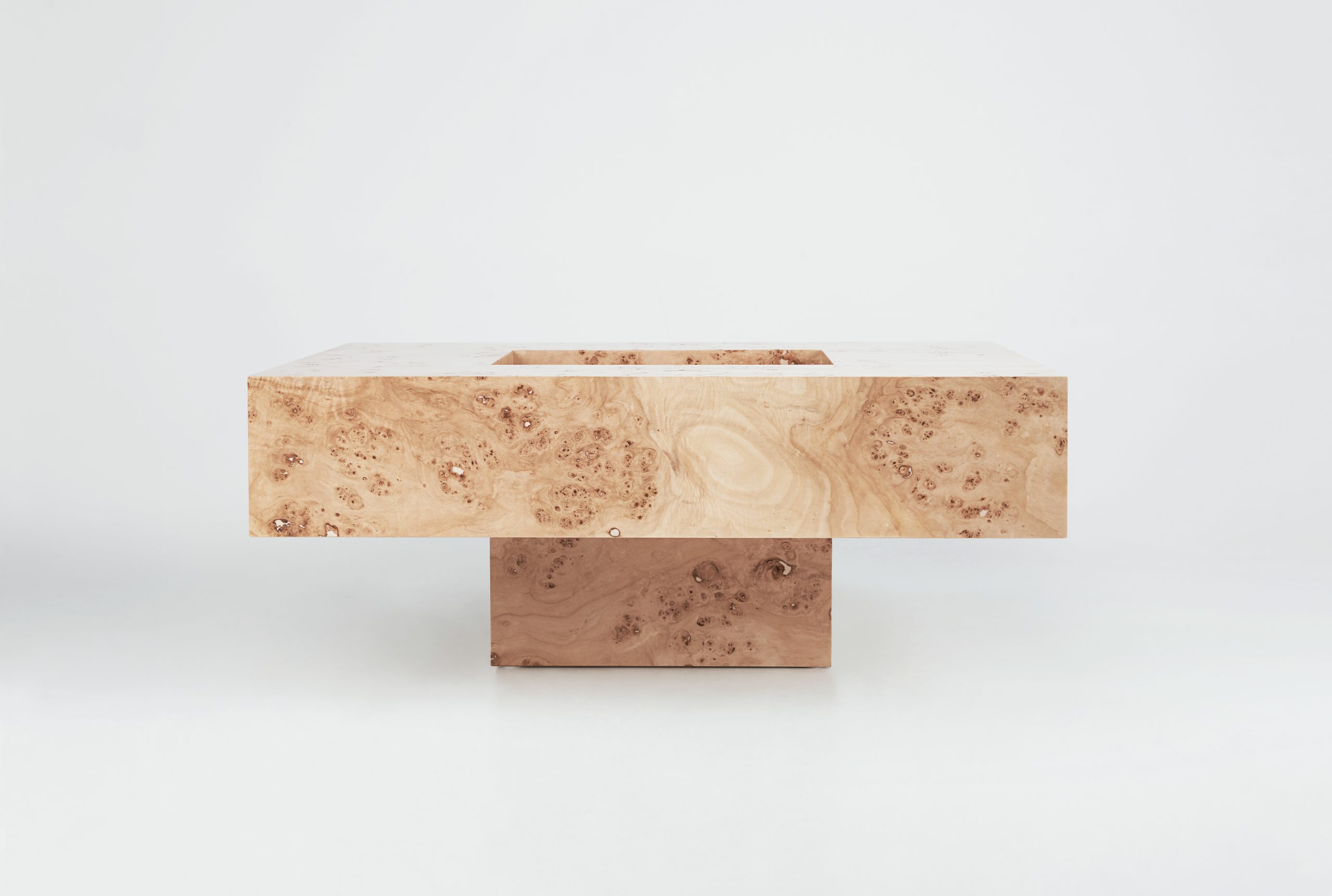
Burl is typically used for the top surface rather than structural elements, combined with solid walnut or brushed steel bases that provide stability and allow the grain to be the undisputed focal point of the piece. The result reads as sculpture first and furniture second – appropriate for rooms where the coffee table is intended to be the primary visual statement in the space. Burl suits paired-back, neutral schemes that give the grain room to perform.
A stainless steel coffee table or metal coffee table brings precision, visual lightness and industrial honesty to a living room that heavier materials cannot offer. Brushed stainless steel – the most common contemporary finish – reflects light softly without the aggressive glare of a polished surface. It pairs naturally with stone tops, concrete floors and monochromatic palettes.
Steel is also the most practical surface for households that prioritise ease of cleaning. Wipe clean with a damp cloth; occasional use of a stainless steel polish restores the brushed finish if it develops surface marks over time. Combined with a travertine or marble top, a steel-base coffee table achieves the best of both material worlds – organic texture above, engineered precision below. Homes & Gardens’ interiors coverage consistently highlights steel-and-stone combinations as one of the defining material pairings of the current decade.
A glass-top coffee table is the best choice when visual lightness is the absolute priority – when a small room needs to feel larger, or when a heavy sofa and dark floor make a solid-top table feel visually oppressive. Glass allows the floor to remain visible, reducing the perceived mass of the furniture arrangement as a whole.
The trade-offs are significant, however. Glass requires more frequent cleaning than any other surface, shows every fingerprint immediately, and is entirely unsuitable for homes with young children or active pets. For most modern interiors, the same visual lightness can be achieved more durably with a slim-leg steel or solid walnut table in a pale, natural finish – without the maintenance burden or safety concerns.
Material Comparison Table
| Material | Aesthetic | Durability | Maintenance | Best For | Petra Madalena Finish |
|---|---|---|---|---|---|
| Walnut | Warm, organic, timeless | Very high | Light oiling 1-2x/year | Warm or neutral interiors, everyday use | Natural oil, matte |
| Travertine | Textured, mineral, sculptural | High | Annual sealing | Minimal, neutral, warm-tone rooms | Honed or filled finish |
| Burl wood | Dramatic, one-of-a-kind, artistic | High | Light oiling 1-2x/year | Rooms where table is the primary focal point | Natural, unfilled grain |
| Stainless steel | Clean, precise, industrial | Very high | Wipe clean, occasional polish | Contemporary, monochromatic, urban schemes | Brushed satin |
| Marble | Luxurious, classical, cool | High | Sealing + careful acid avoidance | Formal spaces, lower-traffic rooms | Honed or polished |
| Glass | Light, transparent, minimal | Medium | Frequent cleaning required | Small spaces needing visual lightness | Clear or smoked |
Coffee tables with storage solve one of small living rooms’ most persistent problems – visible clutter – by hiding remotes, books, chargers and folded blankets behind clean exterior surfaces. A storage coffee table adds useful organisation without adding visible volume or complexity to the room.
A lift-top coffee table is the most versatile storage format for rooms under 25 m² (270 sq ft) because it simultaneously serves as a display surface, a dining table for solo meals, and a working-from-home desk in a single piece of furniture. The lift mechanism raises the top panel to approximately 65-70 cm (26-28 in) – a comfortable working height – transforming the table’s entire function in one smooth movement.
When buying or commissioning a lift-top table, inspect the mechanism quality above everything else. Budget hydraulic pistons lose their tension within two to three years of daily use, leaving a top that no longer holds position. A bespoke lift-top in solid walnut with a quality mechanism is a significant long-term saving compared with replacing a budget version every few years.
Coffee tables with storage drawers provide the most discreet form of everyday organisation. From the outside, the table reads as a clean, solid surface; inside, a single deep drawer can contain a television remote, a charging cable, a notebook and a pair of reading glasses without any of those objects being visible. This is particularly useful in open-plan spaces where the living area is visible from the kitchen or entrance hall.
Solid-wood drawers on wooden runners are worth specifying over plastic-glide alternatives when commissioning a bespoke piece. They open and close smoothly from day one and do not develop the squeaking or sticking that inexpensive drawer hardware produces within a year or two of regular use.
A coffee table with a lower shelf provides open storage that doubles as a deliberate display opportunity. A row of art books, a small basket with a folded throw, or a low ceramic bowl on the lower shelf adds visual depth to the table without crowding the top surface. The key is treating the lower shelf with the same editorial restraint as the top – one or two objects with clear intention, not a landing zone for everything that lacks another home.
A large upholstered ottoman used as a living room table addresses both the sharp-corner safety issue and the surface-clutter problem in a single piece. Place a firm tray on the upholstered surface to create a stable base for drinks and objects. Many ottomans also open internally for additional storage. The main trade-off is surface area – an ottoman provides less usable top surface than a solid-top table of the same footprint, which limits its practicality in households that use the table heavily as a functional working or dining surface.
The most common coffee table styling mistake is overcrowding. A well-styled surface uses a maximum of three grouped elements at varying heights, anchored by a tray, with at least 40% of the surface left completely clear. Restraint is the technique – not the absence of creativity.
Odd-numbered groupings – three objects rather than two or four – create visual interest without tipping into formal symmetry. The three elements should differ noticeably in height: one tall (a vase, a candle, a slender vessel), one mid-height (a sculptural object or small bowl), one low (a flat stack of two or three books). This variation in height produces a small, deliberate skyline effect that draws the eye gently across the surface rather than letting it land on a flat, undifferentiated plane.
Avoid placing objects of identical height side by side. Two matching candle holders of the same size read as a retail display rather than a considered, lived-in arrangement.
A tray is the single most effective tool for coffee table styling because it creates a defined zone for objects, signals clear visual intention, and allows the entire surface to be cleared for use in a single movement. Choose a tray proportional to the table – typically 40-60 cm (16-24 in) long for a standard rectangular modern coffee table. Brass, black steel, marble and natural wood are all appropriate tray materials; the key is that the tray’s material echoes at least one other material already present elsewhere in the room.
Position the tray slightly off-centre rather than perfectly centred on the table. An arrangement pushed toward one end reads as more natural and less deliberately staged than one with everything symmetrically placed.
A living element – a small potted plant, a cut stem in a bud vase, or a lit candle – activates a coffee table arrangement in a way that purely decorative objects cannot replicate. It implies the space is in active, comfortable use. Small-scale living elements work better than large gestures: a single eucalyptus stem in a narrow vessel, a low-profile succulent, or a cluster of three tea lights in simple holders achieves more than a full floral arrangement that competes with every other element on the surface.
Remote controls, charging cables and stacked magazines are the three most common surface disruptors. The Guardian’s homes and interiors editors consistently note that visual clutter is the single most cited complaint about living room design – and the coffee table surface is where most of it accumulates. Remotes belong in a drawer or a small basket; cables should be routed out of sight entirely; magazines are far better stored vertically on a lower shelf where their spines create visual texture without dominating the top surface. A stack of two or three design books is acceptable and adds warmth – a pile of ten is clutter, regardless of how beautiful the individual covers are.
Professional designers style coffee tables using a five-step formula that balances texture, height and negative space – and consistently leaves at least 40% of the surface completely clear. The formula works for every table shape and material, from a stone coffee table in a minimal scheme to a warm wood coffee table in a more layered interior.
The tray is always the first decision because it defines the zone in which all other objects will live. Use a rectangular tray on a rectangular coffee table; a round tray on a round or oval surface. Choose a material with genuine visual presence – marble, aged brass, solid walnut – rather than lightweight wicker or moulded plastic, which are visually overwhelmed by whatever is placed inside them. The tray should occupy 30-40% of the table’s total surface area.
Two to three books placed horizontally inside or alongside the tray create the base layer of the arrangement. Art books, design monographs and architecture titles in plain linen or matte covers are the best choice – avoid books with busy photographic covers, which compete visually with everything placed above them. The stack provides a mid-height platform on which a sculptural object can rest, adding a level of height variation that a flat tray alone cannot produce. The guide to mixing stone, wood and metal in design offers useful thinking on material and texture layering that applies equally well to decorative object selection on a designer coffee table.
A single sculptural object placed on top of the book stack or beside it is the most personal element of the arrangement – a small ceramic, a polished stone, a handmade vessel, a piece of raw mineral. The object should be visually interesting from multiple angles, since it will primarily be viewed from sofa height (approximately 50-60 cm (20-24 in) from the floor) rather than from above. Avoid anything too precious to move – the table needs to function as well as look considered, and an object that cannot be shifted without anxiety defeats the purpose.
Add one living element – a plant, a bud vase with a single stem, a candle – at the tallest point in the composition. A slender stem in a tall, thin vessel creates a vertical accent that lifts the entire arrangement and prevents the composition from reading as flat and front-weighted. The living element should be the visually simplest object on the surface: let the sculptural piece carry the character, let the plant or candle provide the breath. Changing this element seasonally refreshes the entire arrangement without requiring anything else to be moved.
The final step is the most important and the most counter-intuitive: step back from the table, look at it as a whole, and remove one object. Most styling arrangements that fail do so because they contain one element too many. The goal is a surface where the eye can rest on each object individually and appreciate the space around it, rather than scanning a crowded composition looking for somewhere to land. When in doubt, the object that looks most obviously decorative is usually the one to take away.
Rectangular coffee tables offer more usable surface area and suit long, straight sofas most naturally; round coffee tables improve traffic flow through a room, soften strong geometric interiors, and are the safer and more practical choice for homes with sectional sofas or young children.
A round coffee table improves flow through a living room because it has no corners to navigate around and no directional orientation that implies a front or back. Movement around it from any side feels natural. This makes it the right choice for open-plan spaces, rooms where children play, and any layout where the sofa floats away from the wall into the room.
Round tables also perform an important compositional role in rooms with strong rectangular geometry. A rectangular sofa, rectangular rug, rectangular windows and a rectangular television console create a grid of parallel lines that can feel rigid. Introducing a circular form at the centre breaks the repetition and adds a visual relief that feels designed rather than accidental.
The trade-off is surface area relative to footprint. A round table with a 100 cm (39 in) diameter has a surface area of approximately 0.79 m² (8.5 sq ft). A rectangular table measuring 110 x 60 cm (43 x 24 in) has a slightly smaller footprint but offers longer usable edges – more natural for placing drinks, setting down a laptop, or laying out a book.
A rectangular coffee table is the most versatile format for the widest range of living rooms because its proportions naturally echo the sofa, the rug, and in most cases the room itself. The visual result is a space that reads as composed and deliberately arranged. It also provides the most flexibility for styling: the horizontal surface divides naturally into distinct zones – a tray zone, a book stack zone, a living element zone – that can be maintained separately without objects competing for visual territory.
For households that use the coffee table as a working or dining surface, a rectangular form offers more practical linear edge length and clearer functional zones than a round alternative of equivalent footprint.
An oval coffee table combines the rounded, corner-free perimeter of a round table with the greater surface area and visual directionality of a rectangular one. For rooms where a round table feels too small but a full rectangular table feels too formal or directional, an oval is often the most satisfying resolution.
Oval tables work particularly well with L-shaped sofas in medium-sized rooms of 20-30 m² (215-325 sq ft), where the curved form echoes the gentle turn of the seating arrangement without the hard linearity of a rectangle pressing against the sofa’s angle.
When everything else is equal, the deciding factor is your room’s traffic pattern. If people move regularly around the coffee table from multiple directions, choose round or oval. If the table sits in a layout where movement is primarily in front of it and behind it along a single corridor of flow, choose rectangular. Proportion and material quality matter more than shape in the long run – a well-proportioned rectangular table in solid walnut will always outperform a poorly sized round table in veneer, regardless of which shape is theoretically more suited to the room.
For homes with young children or active pets, the safest coffee table has rounded or chamfered edges, a sealed hardwood or powder-coated steel surface, and absolutely no glass top. These three criteria together eliminate the most common sources of injury and damage in a family living room.
The edge profile is the single most important safety specification for a family coffee table. Sharp square corners at toddler head height – approximately 45-60 cm (18-24 in) from the floor – represent a significant impact risk for children under five who move quickly and fall unpredictably. Specify a rounded edge, a bullnose profile, or a softly chamfered edge on any table that will be used in a household with young children.
A rounded or chamfered edge is straightforward to specify in a bespoke commission and typically carries no additional cost. Most ready-made coffee tables use a minimal factory chamfer that reduces sharpness to some degree but falls short of the protection a proper radius provides.
Material selection for family households should weigh surface resilience and ease of cleaning over purely aesthetic considerations. Three materials stand out as the most practical options.
Sealed solid walnut or oak is the best family-friendly wood coffee table surface. The sealant prevents liquid from penetrating the grain, making spills straightforward to wipe away with a damp cloth. Avoid open-grain or oil-only finishes in busy households – they absorb moisture and develop visible staining within months of family use. Reapply sealant every 18-24 months under heavy daily use.
Properly sealed travertine and marble are both practical in family homes. Annual sealing closes the pores and prevents liquid absorption, making a sealed stone coffee table as easy to wipe clean as a kitchen worktop. The weight of a stone top also makes it difficult to tip accidentally – a meaningful safety advantage in homes with active children or larger dogs.
Powder-coated steel bases are the most structurally resilient option for family homes. The coating resists chipping, scratching and moisture penetration, and minor damage can be touched up rather than requiring full replacement. A metal coffee table or stainless steel coffee table base paired with a sealed stone or hardwood top combines maximum structural durability with minimum day-to-day maintenance.
Glass is the only coffee table material that should be avoided entirely in households with young children or large, energetic pets. Even tempered safety glass is not unbreakable – a sharp concentrated impact from a toy, a falling object or a pet skidding across a rug can cause a glass top to shatter in ways that are difficult to predict and dangerous to clean up. The safety risk is not proportionate to the aesthetic benefit, particularly when visual lightness is achievable through slim-leg steel or pale natural timber at no greater visual cost and significantly lower risk.
A lift-top coffee table addresses one of family living rooms’ most persistent daily problems: loose objects within reach of small children. When the top is in its lowered, closed position, there is nothing loose, breakable or spillable on the surface. Raised to working height, the contents are above a toddler’s reach. The flat, low profile of a closed lift-top also reduces the head-injury risk compared with a standard fixed-height table of the same dimensions.
When budgeting for a coffee table, spend on material quality and base structure – these two factors determine how long the piece lasts and whether it can be repaired rather than replaced – and save on decorative accessories on the surface, which can be updated seasonally at minimal cost.
Budget-tier coffee tables under €300 ($325) are primarily flat-pack or factory-mass-produced in MDF, particle board or thin-gauge steel tube. Surface finishes at this level simulate more expensive materials – a walnut-effect foil over particleboard, or a printed ceramic tile over a hollow-core frame. These are functional for three to five years of light use but are unlikely to reach ten years without visible deterioration, and they cannot be refinished or repaired when surface wear becomes apparent.
This tier suits first homes, rental properties, or rooms in active renovation where a temporary solution is needed before a longer-term investment becomes practical.
The €300-€1,200 / $325-$1,300 range contains some genuinely solid options – real timber veneer over hardwood cores, solid oak, engineered stone tops in well-finished formats, and quality powder-coated steel. Marble-effect ceramic tops in this range are often more durable than expected. The main limitation is standardised sizing: most mid-range manufacturers produce one or two fixed dimensions that may not correspond precisely to your sofa or room proportions.
This tier suits long-term homes where the room layout is standard and the plan involves upgrading materials when a renovation or house move provides the natural opportunity. The comparison between custom and mass-produced furniture explains the quality and longevity gap between these tiers in clear, practical terms.
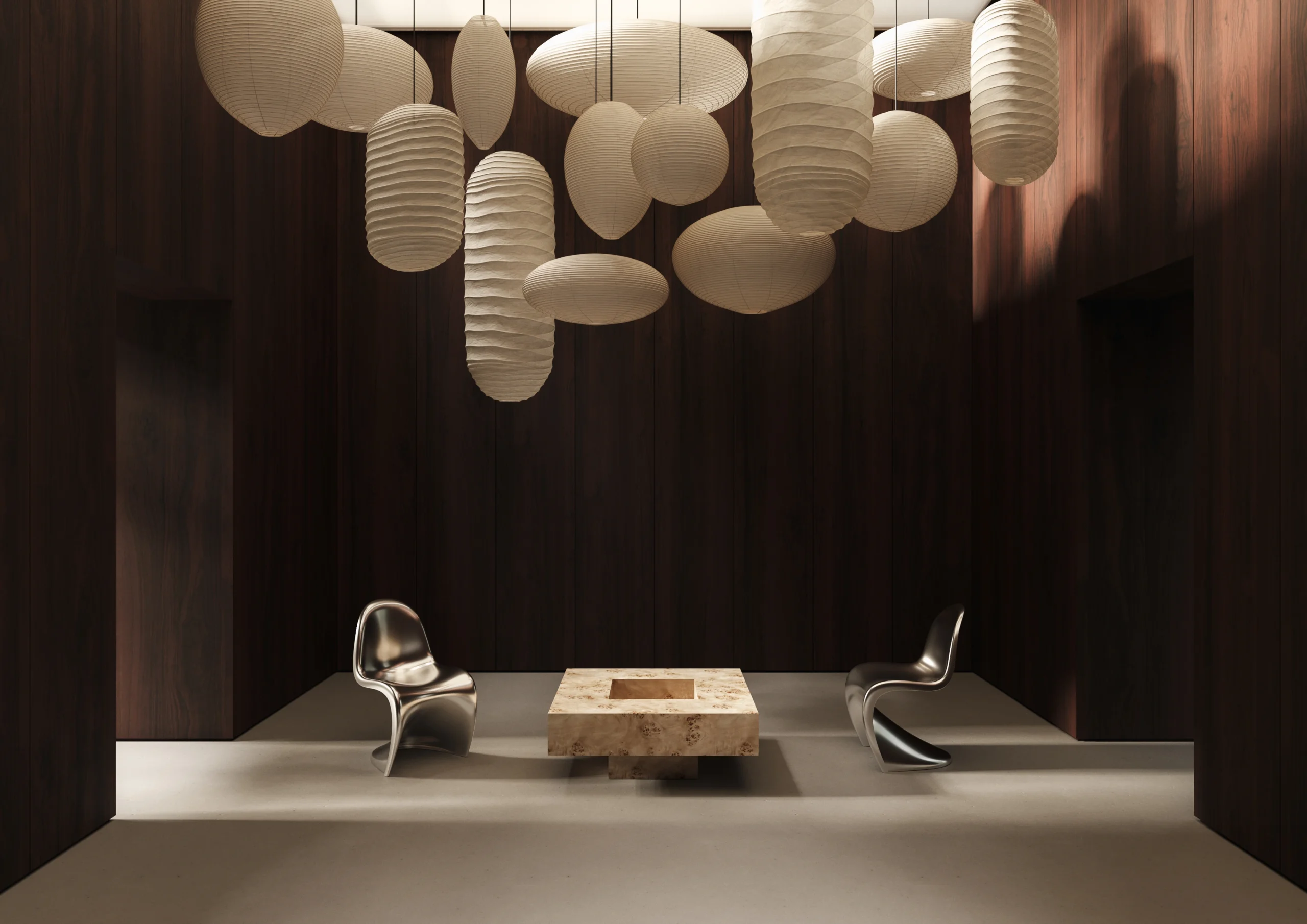
A custom coffee table in the investment tier (€1,200+ / $1,300+) is made to your precise dimensions, material specification and finish – sized to your sofa, your room height and your daily lifestyle. Materials at this level are solid rather than veneered and structural rather than cosmetic.
Petra Madalena’s bespoke coffee tables are commissioned through a design conversation that establishes exact proportions, material combination and functional requirements. The result is a piece that cannot be substituted by any off-the-shelf equivalent at any price point. For the full financial and design case, the guide to whether bespoke furniture is worth the investment in 2026 addresses the cost-versus-value question directly. The benefits of custom furniture covers the practical advantages beyond price alone.
For those new to the commissioning process, how long bespoke furniture takes explains lead times from deposit to delivery – typically 8-14 weeks for a coffee table, depending on material complexity and finish requirements.
Spend on: the top surface material (this is what you see and touch every day, and what ages visibly), the base structure and joinery (these determine long-term stability and repairability), and the edge and corner detail (which affects both safety and the perception of quality every time you look at or pass the piece).
Save on: the decorative tray on the surface (a €25 ($27) marble-effect tray photographs near-identically to a €150 ($163) handmade brass equivalent), coffee table books (available in excellent condition at a fraction of their retail price from second-hand booksellers), and any decorative object that sits on the surface rather than forming part of the table’s structure. These items are replaceable and interchangeable; the table itself is not.
Budget vs Investment Breakdown
| Budget Level | Price Range | What You Get | Expected Longevity | Best For |
|---|---|---|---|---|
| Entry | Under €300 / $325 | Veneer, MDF, thin-gauge steel tube | 3-5 years | Temporary, rental, transitional rooms |
| Mid-Range | €300-€800 / $325-$875 | Real timber veneer, solid oak, engineered stone | 7-12 years | Standard rooms, mid-term homes |
| Premium | €800-€1,200 / $875-$1,300 | Solid timber, quality stone-effect or ceramic top | 12-20 years | Long-term homes, good quality/size match |
| Investment | €1,200-€3,000 / $1,300-$3,250 | Solid walnut, travertine slab, steel base | 20-40+ years | Forever rooms, exact sizing required |
| Bespoke | €3,000+ / $3,250+ | Any material combination, exact dimensions, designed for your room | Indefinite with care | Heirloom quality, full design freedom |
Ready to commission a coffee table sized precisely for your room and crafted from the material that suits your life? Explore Petra Madalena’s collection or begin a bespoke design conversation.
Explore Our Coffee Table Collection →Choosing a coffee table is one of the most impactful decisions in any living room because it is the piece of furniture you live closest to – you set your drinks on it, rest your feet on it, lean across it in conversation, and look at it every time you sit down. The right table in the right material, sized correctly for your sofa and room, changes the quality of the space in a way that is immediately felt even when it cannot be precisely articulated. Most manufacturers treat the coffee table as a background object. Petra Madalena treats it as the most visible piece in the room – a sculptural form that happens to be functional, rather than a functional object that happens to have some form. A table for coffee made specifically for your room, in a material that improves with years of careful use, is not a luxury purchase – it is the most practical choice available, because it will never need replacing and will never stop being worth looking at.
Every piece in this guide — walnut, travertine, burl wood, solid birch — is available to explore in full detail in the Petra Madalena catalogue. Browse materials, finishes and forms, or use it as a starting point for a bespoke commission sized to your exact room.