 Menu
Menu
Menu
Menu

The shortest answer is this: a bookcase or cabinet from a serious workshop is not a storage box, it is a sculptural object that performs a quiet, daily function in your home for decades. Bespoke storage furniture is made once, for one space, with veneers selected piece by piece. Pieces from Petra Madalena are designer-resolved sculptural objects rather than catalogue items – clients choose veneer, finish, and dimensions, but the form itself has already been resolved by the designer. Combined with a 9-week production window and natural veneers no flat-pack producer can replicate, the result is a piece that earns its place against any wall, in any home, for a generation.
A bookcase is an open piece designed to display books and objects on view, while a cabinet uses doors to conceal what sits inside. The difference sounds small until you think about what each one says about the room around it. Open shelves announce; closed doors withhold. The most interesting interiors usually contain both.
Open storage works hardest when it is treated as a vertical canvas rather than a place to put things. A bookcase positioned in a living room sets a visual rhythm: horizontal shelves cut across the wall, books and objects fill them, and the whole composition reads as one large piece of art. Sculptural bookcases push this further by abandoning the standard rectangular grid altogether – a stacked-cube column, an irregular tower, or a piece with offset depths turns ordinary shelving into something closer to a freestanding sculpture. Our piece on sculptural bookcase design covers this territory in depth.
Closed storage solves a different problem: it gives a room visual rest. Custom cabinets built with proper veneer faces, grain-matched doors, and clean edges can read almost like wood panelling, dissolving into the architecture rather than competing with it. This works particularly well in rooms already full of visual information – art on the walls, textiles on the sofa, objects on every surface. A well-made cabinet provides the calm and quietly hides the daily chaos: cables, paperwork, board games. The discipline of choosing what to display openly and what to conceal is what separates curated rooms from cluttered ones.
Closed cabinets earn their keep in living rooms, hallways, and bedrooms – rooms where visual calm matters more than display. The same piece in a kitchen would be wasted: those rooms already have built-in cabinetry doing the same job.
A bookcase cabinet is the hybrid that solves the open-versus-closed question by refusing to choose. Open shelves sit above or beside closed compartments, giving you both display space and concealed storage in a single object. This is one of the smartest configurations for living rooms and home offices – it lets you keep ten or fifteen carefully chosen objects on view while hiding fifty pieces of necessary clutter behind doors. Within this category there are two distinct approaches, and the choice between them shapes the whole room.
The conventional cabinet bookcase is a utility-first piece designed to disappear into the room while doing a job. Open shelves at the top hold books, closed cabinet doors at the bottom hide paperwork, cables, and clutter. The form is usually rectilinear, the proportions standard, and the goal is to be useful without drawing attention. This is what most catalogues mean by the term, and it is a perfectly reasonable choice when the room itself is the focal point and the furniture is meant to recede.
The sculptural cabinet bookcase is a form-first piece designed to be looked at. Instead of cabinet doors, it might use staggered open compartments, asymmetric stepped forms, carved recesses, or continuous figured veneer that draws the eye across every surface. Storage still happens – books and objects sit inside the compartments – but the architecture of the piece is the primary statement. The Petra Madalena collection sits firmly in this second category, where each piece is conceived as a sculptural object before any thought is given to how many books it will hold.
| Feature | Conventional Cabinet Bookcase | Sculptural Cabinet Bookcase |
|---|---|---|
| Primary Goal | Functional storage that recedes | Sculptural form that anchors |
| Compartments | Closed doors + open shelves | Open, staggered, asymmetric forms |
| Material Choice | Standard hardwood, MDF, or veneer | Figured veneer, walnut burl, solid hardwood |
| Visual Weight | Disappears into the room | Acts as a focal point |
| Best For | Practical storage in busy households | Considered interiors, design-led homes |
A well-designed sculptural bookcase cabinet often eliminates the need for a separate sideboard, console, or accent piece, because the bookcase itself is the art object the room would otherwise need. This is especially valuable in apartments where every square metre matters: one considered piece that works as both function and focal point delivers far more lasting value than a collection of single-purpose items.
The vocabulary around storage furniture is older than most people realise. According to the Victoria and Albert Museum in London, the freestanding bookcase as a furniture form only emerged in the late seventeenth century, with one of the earliest known examples built for the diarist and naval administrator Samuel Pepys in 1666. The cabinet has an even longer history, with roots in the Renaissance “cabinet of curiosities” – a piece designed to display rare and valuable objects to guests. Both forms still carry that DNA today.
Bespoke storage is worth the investment because it does three things mass-produced furniture cannot: it fits your specific space, it uses materials that age well, and it holds its value over time. The upfront cost is higher, but the cost-per-year of ownership is almost always lower – the piece does not need replacing in three years, or five, or fifteen.
The first reason bespoke matters is fit. Standard furniture is produced in fixed dimensions and rarely suits the actual proportions of a real room – a bookcase ten centimetres too tall reads as cramped, a cabinet fifteen centimetres too short leaves an awkward gap to the wall. Petra Madalena works from designer-resolved sculptural forms that clients adapt by choosing veneer, finish, and size, so the proportions are correct without sacrificing the visual integrity the designer built into the original piece.
The deeper reason bespoke matters is what the production process protects. Mass-produced board furniture is optimised for shipping flat and assembling fast – materials chosen for cost, joints chosen for speed. Cabinet craftsmanship in a small Lithuanian workshop is optimised for an entirely different goal: making one good piece that will still be in the room thirty years from now. Edges are finished rather than covered, grain is matched across panels, veneers are selected piece by piece for the specific commission. None of that is possible at industrial scale. It also lasts: according to a life cycle assessment of 25 furniture pieces published in Nature’s Scientific Reports, the environmental impact of any furniture piece is heavily determined by how long it stays in use, which is exactly what durable construction protects.
A well-made bookcase or cabinet behaves more like a piece of design than a piece of furniture, which means it tends to hold or even grow in value as time passes. The wider market reflects this. According to Verified Market Research, the global bespoke furniture sector was valued at approximately USD 16.1 billion in 2024 and is projected to exceed USD 24.3 billion by 2030, driven by a clear consumer move away from disposable mass-production toward considered, long-term pieces. Our article on furniture that increases home value looks at the numbers in depth.
The materials that define sculptural bookcases and cabinets in 2026 are natural wood veneers – particularly walnut, burl, and palissandro – finished in matte, semi-matte, or glossy lacquer. Material is the single biggest decision a buyer makes after form, and it determines almost everything about how a finished piece reads in the room.
Natural wood veneer outperforms solid wood for sculptural furniture because it gives you the visual richness of rare timber without the dimensional instability of solid wood. Solid wood expands, contracts, and cracks as humidity changes through the year. For a sculptural piece with carefully resolved proportions, even a millimetre of movement matters. Veneer applied over a stable engineered core behaves predictably across decades, and lets the workshop select the most striking grain pattern from a single log and grain-match it across an entire piece. That is how you get the long, continuous figuring across a cabinet door or the bookmatched pattern across a bookcase column – effects essentially impossible to achieve in solid wood. Plain MDF without veneer, by contrast, sags under weight and rarely survives a single house move. Our guide on walnut veneer vs solid wood walks through this comparison in technical detail.
Three veneers dominate the most considered sculptural storage in 2026: walnut, burl, and palissandro santos. Each has a distinct visual personality and suits a different kind of room.
Oak deserves an honourable mention too – lighter, with a more pronounced grain and a versatility that lets it sit alongside almost any palette – but the three below are the ones worth knowing first.
Each of the three reads differently in a finished piece, and the easiest way to see that is side by side.
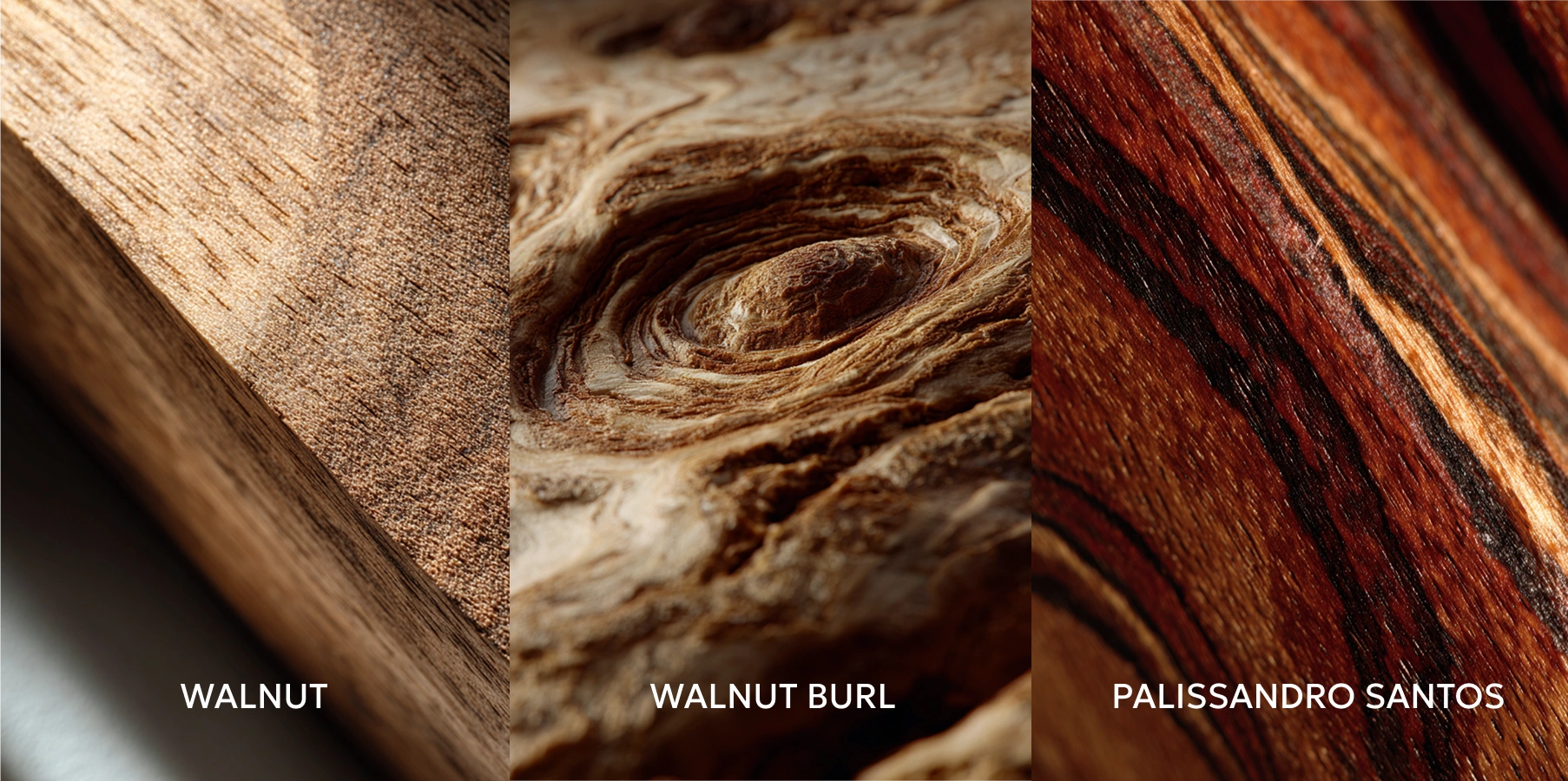
Walnut is the calmest of the three. The grain is even and rhythmic, the colour sits in a warm mid-brown range, and the wood reads as quietly luxurious without demanding attention. Walnut cabinets work in almost any interior because the timber has been the default choice of serious cabinetmakers for two centuries. It pairs with pale plaster walls, deep painted rooms, marble, linen, brass.
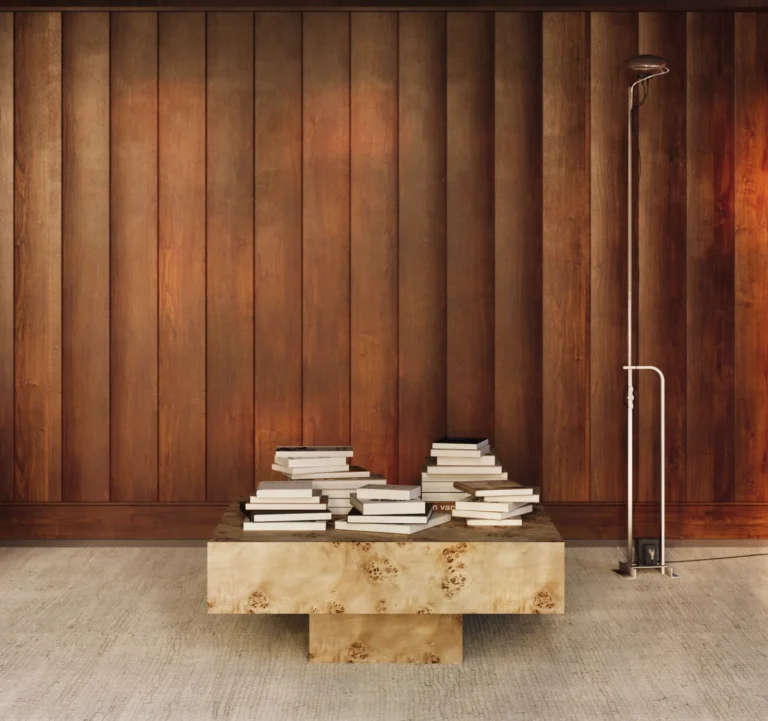
Burl is the opposite. It is the dense, swirling growth that forms on the trunk of certain trees in response to stress, and the resulting wood looks more like a topographical map than a flat surface. A burl-faced cabinet is a statement piece by default, suited to rooms that can support a strong central focal point.
Palissandro santos sits between the two. The wood carries deeper red-brown tones than walnut and a more visible, more dramatic grain, without going as far as burl. A palissandro wood bookcase brings real depth to a room without overwhelming it.
The finish changes everything about how the wood reads in a room. For a Petra Madalena commission, finish is one of three client choices alongside veneer and dimensions, so the same sculptural form can read entirely differently from one home to another.
Matte absorbs light and emphasises the texture of the grain itself, which is why it works so well on burl and other heavily figured veneers – the eye reads the wood rather than the reflection.
Semi-matte offers a soft sheen that catches light without bouncing it harshly. It tends to be the default choice for walnut and most smooth-grained veneers.
Glossy is the most theatrical. Light reflects off the surface and the wood reads almost like a lacquered art object. It works best in rooms with controlled lighting where the piece is the clear focal point.
Choosing the right modern bookcase for your living room comes down to four questions: where will it sit, how tall, deep, and wide should it be, what should it speak to in the rest of the room, and what will live on it. Get those four right and the bookcase becomes the quiet anchor of the whole space.
A bookcase should sit where the eye naturally lands when you enter the room, but not directly in the main sightline from the entry. The strongest placements: opposite a sofa, behind a sofa as a backdrop, flanking a fireplace, or in a quiet corner. Avoid placing a tall bookcase directly beside a television – the two will compete and neither will win. Living room storage works best when each piece has its own breathing space and clear visual role.
A bookcase should be tall enough to draw the eye upward and ground the wall, but not so tall that it crowds the ceiling. For standard ceilings between 2.4 and 2.7 metres, a bookcase between 1.6 and 2.0 metres reads best. The 165 cm height used on several Petra Madalena pieces is deliberate: tall enough to read as architectural, short enough to leave breathing space above. Lower pieces around 100 cm work as console-height anchors beside a sofa or in a hallway, where the form reads at eye level when you walk past. Either way, leave at least 20 to 30 cm of breathing room above the piece so the form can read against the wall. Our guide on modern bookcases for living rooms covers placement and proportion in more depth.
A sculptural bookcase should typically be 25 to 40 cm deep and 70 to 200 cm wide, with the exact figures driven by the form of the piece and the proportions of the room. A 25 to 30 cm depth is enough to fit standard hardcovers and paperbacks without leaving books pushed too far back, while a deeper profile of 35 to 40 cm allows for more substantial sculptural forms and accommodates larger objects, art books, or ceramics. Anything deeper than 40 cm starts to feel architectural and crowds smaller rooms. For width, a standalone piece usually ranges from 70 to 120 cm; as a general rule, it should occupy less than two thirds of the wall it sits on, so the wall itself becomes part of the composition.
A bookcase should relate to the rest of your furniture without literally matching it. Matching is what hotel suites do; relating is what considered homes do. The relationship can be tonal (walnut echoing walnut), material (wood speaking to wood across species), or textural (smooth glossy cabinet against a boucle sofa). A sculptural wooden bookcase can also act as the strongest piece in the room – the one everything else relates to.
A bookcase can work in any room where you spend time, not only the living room. The piece needs to earn its place visually as well as functionally, and the right form depends on the room.
Hallways suit narrow vertical bookcases that turn dead wall space into a focal point. A sculptural column piece works particularly well, drawing the eye upward in spaces that are otherwise visually flat.
Bedrooms benefit from lower bookcases that double as bedside or window-side surfaces. A waist-height piece can hold books, a lamp, and one or two carefully chosen objects without dominating a room dedicated to rest.
Home offices need the obvious functional bookcase, but sculptural choice matters more here than anywhere – the piece will sit in your peripheral vision for hours a day.
Three Petra Madalena pieces capture the range of what sculptural storage can be in 2026: the Walnut Veneer Bookcase, the Palissandro Santos Bookcase, and the Walnut Burl Storage Cabinet. Each is a designer-resolved sculptural object adaptable by veneer, finish, and dimensions.
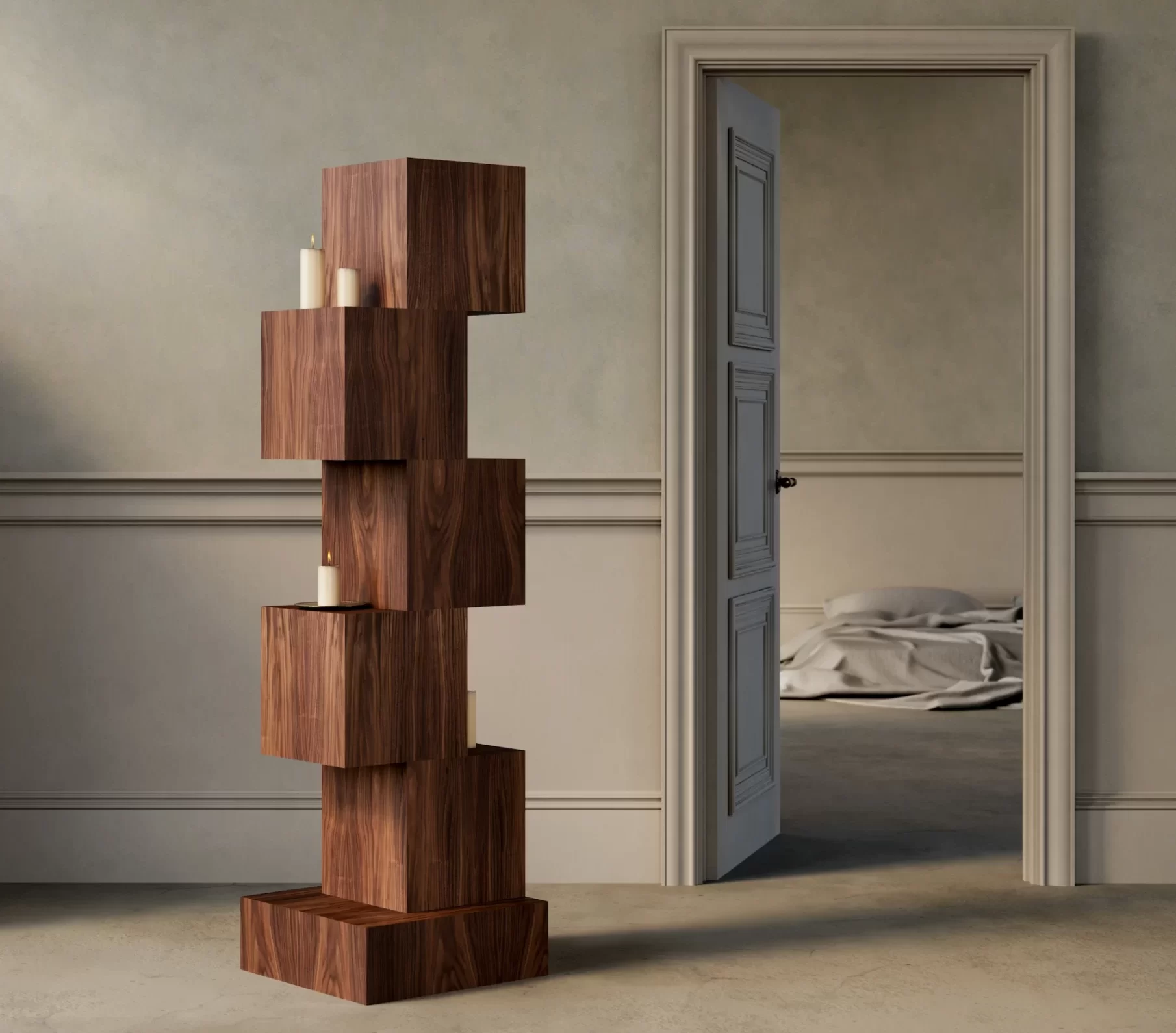
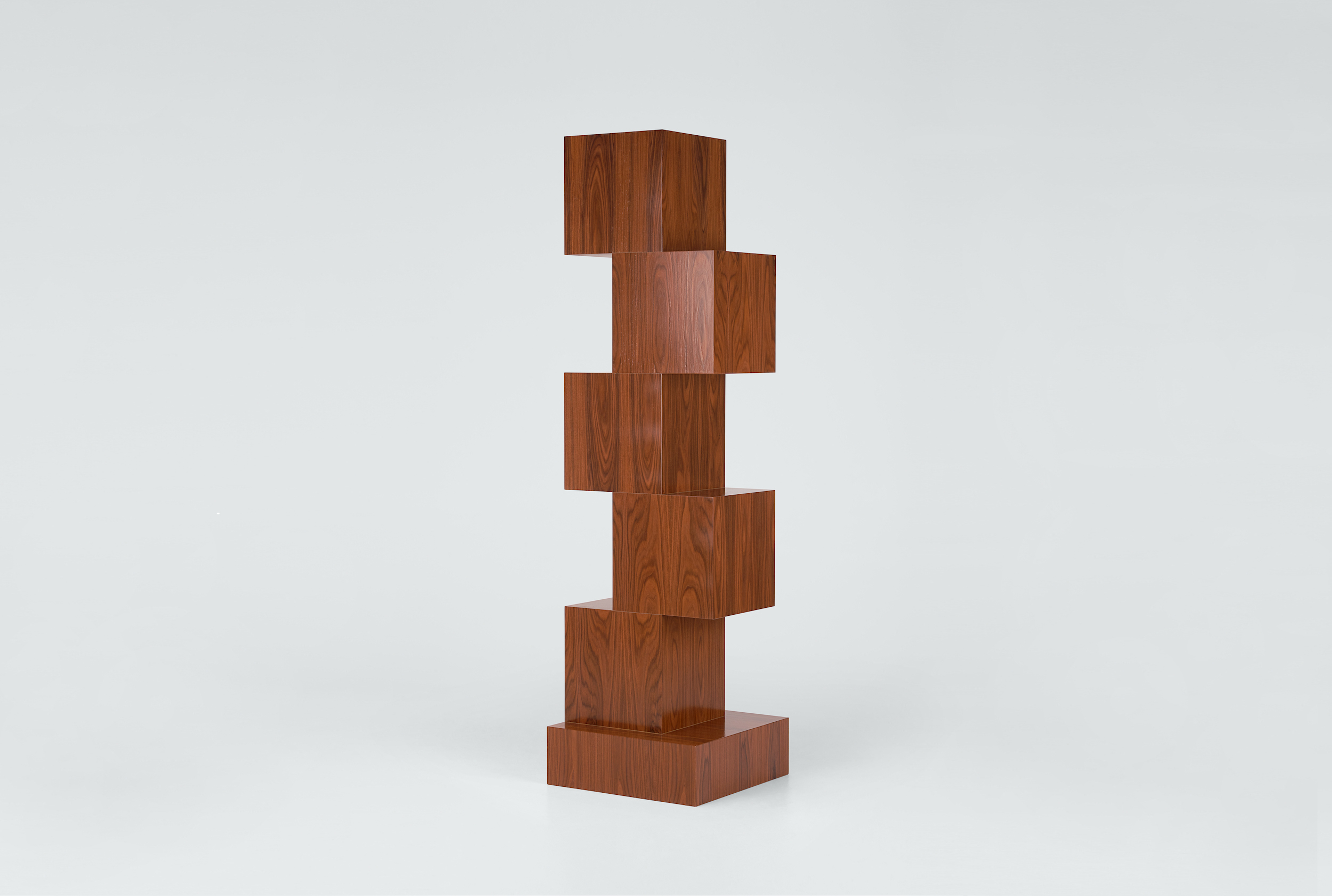
A vertical column of five offset cubes, each shifted slightly from the one below, resolving into a single sculptural figure that reads almost as a totem. Walnut veneer gives the piece its warm mid-brown tonality and even, rhythmic grain.
The Walnut Veneer Bookcase reads as a sculpture first and a bookcase second. Five offset cubes stacked vertically and finished with a base plinth give the piece the gravity of a column without losing the openness of a shelving unit. At 45 by 45 cm in plan and 165 cm tall, it occupies a small footprint but commands real visual presence – ideal for a corner that needs an anchor or a wall that needs a single strong vertical line.
The same sculptural geometry as the Walnut Veneer Bookcase, re-voiced in deep red-brown palissandro santos. The richer tone changes the personality of the piece entirely.
The Palissandro Santos Bookcase demonstrates how the same resolved form can read completely differently depending on the veneer chosen. Where the walnut version sits quietly, the palissandro version dominates – in the best way. The deeper red-brown tone and more pronounced grain give the five-cube column a warmer, almost amber quality under evening light. This is also the version most often specified in glossy finish, where the lacquer turns the wood into something close to a polished art object.
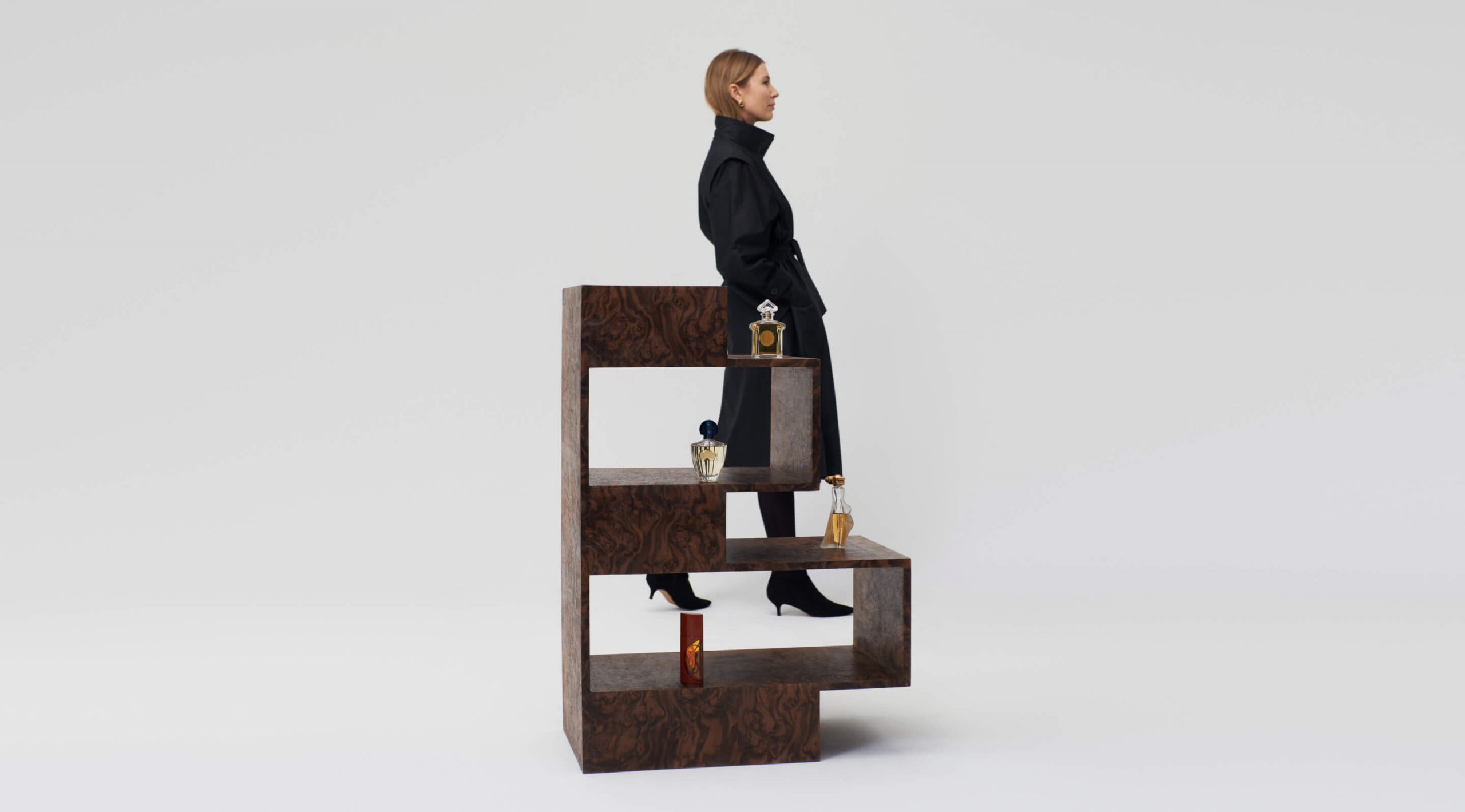
An architectural composition of solid mass and open openings, finished in walnut burl. The swirling figuring turns the entire piece into a single sculptural surface.
The Walnut Burl Storage Cabinet is the most architectural of the three, built on a logic of solid mass cut through by two open chambers rather than stacked verticality. The form reads almost like cut stone – wood excavated rather than assembled. At 70 by 40 cm in plan and 100 cm tall, it suits smaller rooms, hallway niches, or low walls where a taller piece would not fit.
The table below compares the three featured sculptural objects on form, scale, material approach, and the kind of room each suits.
| Piece | Form | Dimensions (cm) | Material Approach | Best Suited To |
|---|---|---|---|---|
| Walnut Veneer Bookcase | Vertical column of stacked offset cubes | 45 x 45 x 165 | Warm walnut veneer; calm rhythmic grain | Corner anchor; calm contemporary rooms |
| Palissandro Santos Bookcase | Same stacked-cube column, deeper tonality | 45 x 45 x 165 | Deep red-brown palissandro; dramatic grain; often glossy | Focal-point rooms; evening-lit interiors |
| Walnut Burl Storage Cabinet | Architectural mass with open chambers | 70 x 40 x 100 | Heavily figured walnut burl; topographic surface | Small rooms; hallway niches; statement piece |
A well-decorated bookcase looks considered because every object on it has been chosen, not just placed, and because negative space between objects is treated as a design element in its own right. The single biggest mistake people make is trying to fill every shelf. There is a cognitive reason for this: according to research from the Princeton University Neuroscience Institute published in The Journal of Neuroscience, when multiple objects compete in your visual field the brain works harder to filter them, which drains attention over time. A well-composed, edited piece quietly resolves this.
The rule of threes is the working principle most interior stylists use because odd-numbered groupings read as more natural and visually interesting than even ones. Three objects of different heights and textures, arranged in a loose triangle, will almost always look better than four matched items in a row. Combine this with deliberate negative space – leaving roughly thirty to forty percent of each shelf empty – and the bookcase starts to read like a curated gallery wall rather than a storage unit. Home storage design at its best is about subtraction more often than addition.
Books should sit on a bookcase, but they should not dominate every shelf. The most beautiful bookcases use roughly half of their shelves for books and half for objects – ceramics, small sculptures, framed photographs, a vessel. Vary orientation: some books vertical, some stacked horizontally with a small object on top. Group books by colour or binding type for visual cohesion. A considered bookcase evolves slowly. Our full guide on how to decorate a bespoke bookcase covers the discipline in more practical detail.
Empty space on a sculptural piece is not wasted space – it is what lets the form itself read. A small lamp on top, picture lights mounted above, or warm LED strips along the underside of an open compartment can turn modern storage into a focal point. In living rooms where the piece doubles as evening ambient lighting, the figured grain of walnut or burl catches the light and shifts character throughout the day, which is part of why these pieces never feel static.
The most common bookcase mistakes are easy to fix once you know what to look for, and each one undermines the sculptural object you bought in the first place.
Overfilling turns a sculpture into a wall of clutter. Aim for thirty to forty percent negative space on every shelf.
Too many small objects of similar size make the eye skid across the surface without resting. Mix scales: a large vessel with two smaller objects beats five matched items.
Matching everything to one colour palette can feel sterile. One or two accent colours work better than a rigid monochrome rule.
Never use a bookcase for objects you do not want to look at every day. If a piece is not earning its place on the shelf, it belongs in a cabinet, a cupboard, or out of the house entirely.
Yes, quality bookcases and cabinets increase the perceived value of a home, particularly when they read as fitted, considered, or sculptural rather than as generic storage. Estate agents have used the language of “bespoke,” “built-in,” and “fitted” in listings for years because those words signal craftsmanship to buyers and consistently support a higher asking price.
Buyers notice built-in quality because the eye reads it immediately, even before the conscious mind can articulate why. A wall lined with a sculptural bookcase or a well-made cabinet tells the viewer that the home has been treated with care and that the previous owner invested in the long term. This perception spreads to the entire room and, often, the entire property. The piece becomes a visible signal of overall quality. Storage solutions at this level operate as architectural elements rather than as furniture.
Sculptural storage holds its value the way good design objects hold theirs: by being well-made enough to outlast trends and singular enough to retain identity. The veneer develops patina over time, the joinery stays tight because it was made tight, and the form remains visually current because it was designed as a sculptural object rather than as a fashion item. Many of the most highly valued antique pieces in museum collections are simply well-made cabinets and bookcases that survived because they were worth surviving. The same logic applies to a piece bought new today.
| Factor | Bespoke Sculptural Storage | Mass-Produced Flat-Pack |
|---|---|---|
| Material | Natural wood veneer over stable engineered core; selected piece by piece | Particleboard or MDF with paper or vinyl print finish |
| Construction | Hand-finished edges, grain-matched panels, traditional joinery | Cam-and-dowel fittings, exposed edge tape, machine-cut to standard dimensions |
| Lifespan | Decades; can be refinished and restored indefinitely | Typically 3 to 7 years before structural failure or visual fatigue |
| Production Window | 9 weeks per piece, made once for one client | Continuous production, identical units in volume |
| Resale and Value | Holds or appreciates as a design object | Depreciates immediately; minimal resale value |
| Effect on Home Perception | Reads as fitted, considered, architectural | Reads as temporary, generic, replaceable |
The craft behind a Petra Madalena piece is what separates a sculptural object from a piece of furniture. Every commission begins with a designer-resolved form and ends nine weeks later with a finished object that has been touched, adjusted, and considered at every stage by a small team of Lithuanian craftspeople.
The 9-week production window is the minimum required to make a piece this way. Veneer selection comes first: the workshop chooses the slices of wood that will face the piece, matching grain patterns so the finished object reads as one continuous surface. The engineered core is then built for dimensional stability. Veneer is applied, pressed, trimmed, and sanded. The finish is built up in multiple layers, each sanded by hand before the next. Finally the piece is inspected, packed, and shipped. Our piece on cabinet making as art looks at this process in more depth.
Every Petra Madalena piece is designed and crafted in Lithuania. The country has one of Europe’s deepest traditions in fine cabinetmaking, with workshops that have passed techniques between generations of craftspeople. This matters because sculptural furniture at this level cannot be made by a fast supply chain – it depends on small teams of people who care about the work and have spent years learning how to do it well. The production chain is short, the standards are consistent, and the designer can be present during key stages of the build.
A bookcase or cabinet at this level is not a piece of furniture you buy because you need somewhere to put your books. It is a sculptural object you commission because you want the room to be considered, and because you want the piece to still be there, still beautiful, in thirty years. Bespoke materials, designer-resolved forms, natural veneers, a 9-week production window, and Lithuanian craftsmanship are not luxuries – they are what produces a piece that earns its place against any wall.
For anyone weighing the decision between mass-produced storage and a commissioned sculptural object, the calculation is straightforward: a piece bought once, kept for decades, that adds tangible value to a home and quiet pleasure to daily life. Browse the full collection of bookcases at Petra Madalena or explore the wider catalogue at Petra Madalena.
Every piece is designed by Petra Madalena and crafted in Lithuania, made once for one home, with a 9-week lead time and natural wood veneers chosen specifically for your commission.
Browse Bookcases
Visit Petra Madalena