 Menu
Menu
Menu
Menu


Walking into a room, your eyes naturally gravitate toward focal points. What if your book storage could command that same attention as a gallery-worthy sculpture?
A sculptural bookcase is a storage piece designed as form first and function second, so it anchors a room the way a freestanding sculpture would while still holding books and objects. This guide explains what makes a bookcase sculptural, the materials and craftsmanship behind it, where to place one in a living room and how tall it should be, how to style it without clutter, and why a well-made piece holds its value over time.
Historically, bookcases served a purely utilitarian purpose: hold books and organise collections. Today’s sculptural bookcase carries a completely different philosophy. Petra Madalena creates pieces that challenge conventional notions of what furniture should look like, where each curve, angle, and material choice tells a story beyond mere functionality.
The instinct to treat storage as art is old. During the Renaissance and Baroque periods, wealthy collectors commissioned elaborate cabinets of curiosities, pieces meant to impress as much as to store, with detailed marquetry, gilded decoration, and forms borrowed from temples and palaces. Master makers like Andre-Charles Boulle, Thomas Chippendale, and David Roentgen built cabinets that were almost small buildings, complete with rare materials and hidden compartments. As the Cooper Hewitt, Smithsonian Design Museum notes, wood veneer techniques have been central to furniture innovation for centuries, allowing makers to create stunning visual effects while building structures that last. That lineage runs straight to the modern studio bench.
Traditional rectangular bookcases fade into the background of our daily lives. Sculptural designs, however, become conversation starters and room anchors. Bespoke bookcases offer something mass-produced furniture never can: a unique bookcases proposition where each piece is an artistic statement that reflects your personal aesthetic rather than a catalogue compromise.
| Feature | Traditional Bookcases | Sculptural Bookcases |
|---|---|---|
| Design purpose | Pure functionality | Art meets function |
| Visual impact | Background element | Focal point and statement piece |
| Customisation | Limited sizes and finishes | Fully tailored to your space and vision |
| Materials | Standard wood or laminate | Figured veneer, mixed media, metal, stone |
| Craftsmanship | Mass-produced | Handcrafted by artisans |
| Longevity | Trendy, dates quickly | Timeless artistic value |
| Room integration | Stands alone | Interacts with architecture |
A sculptural bookcase does not just store your collection; it actively enhances your environment’s emotional atmosphere. Custom-made pieces bring numerous advantages that extend far beyond standard furniture options. Bespoke storage also works as a whole category, with bookcases and cabinets together shaping how a home reads; our complete guide to bespoke bookcases and cabinets sets out the broader context, covering materials, proportions, decoration, and home value alongside the artistic principles explored here.
A truly sculptural piece is defined by its form first and its function second. Where traditional bookcases lean on symmetry, carved detail, and dark stained finishes, a contemporary piece treats the bookcase as an object in its own right, something closer to a sculpture than a wall of storage. The silhouette is the design, and the grain of the wood is the decoration. Several things set these pieces apart.
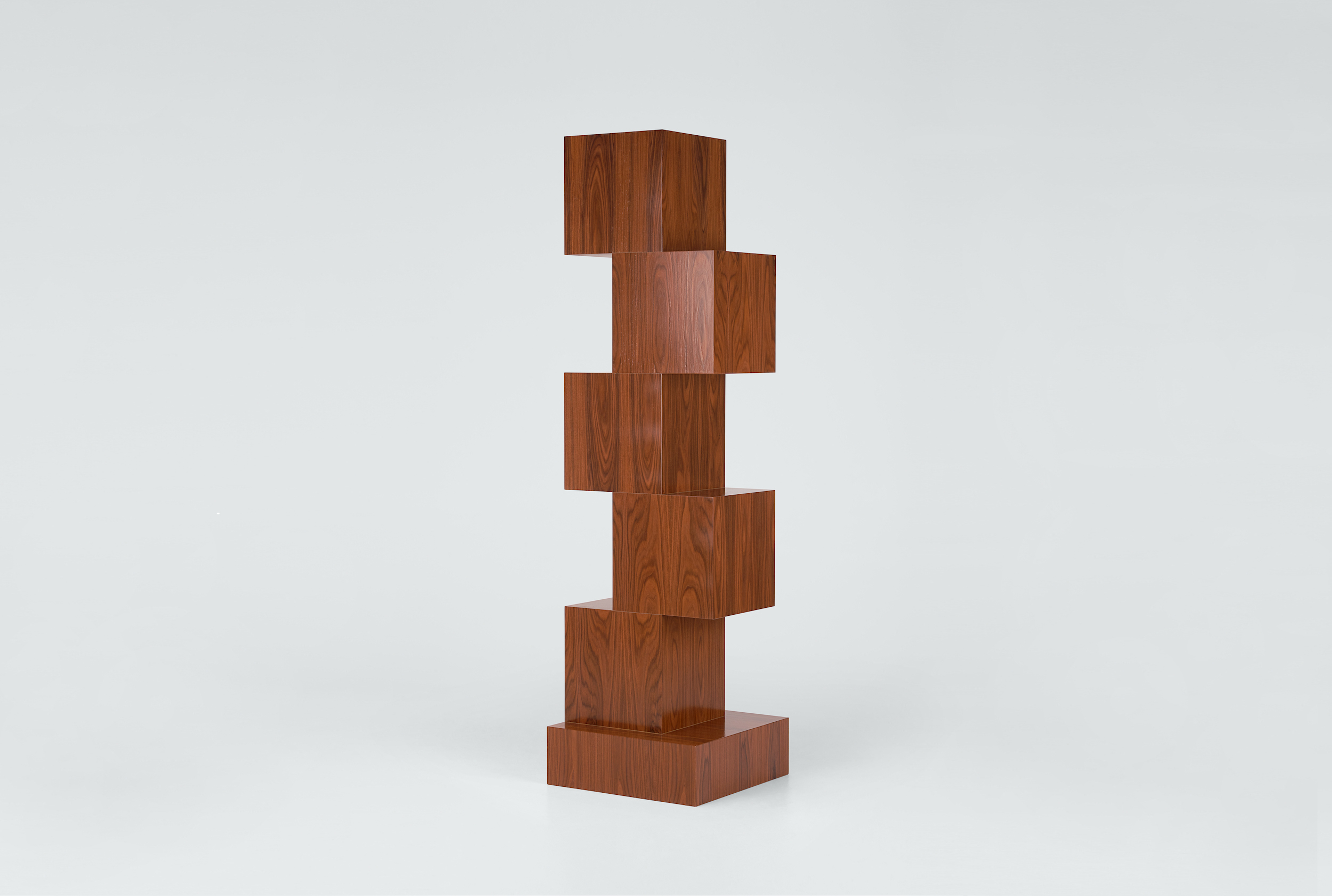
Sculptural pieces often abandon the standard rectangular grid: flowing curves that echo natural forms, bold geometric volumes, stacked cubes, or off-balance compositions that lead the eye across the piece. A silhouette might reference architectural elements like columns and arches, or draw from nature, flowing water and rock formations. This is what lifts a piece from background object to room-defining statement.
How materials work together adds another layer. Contemporary makers combine solid woods with bronze, glass, stone, and metal to create unexpected effects, a polished bronze base holding a walnut body, or glass panels that reveal a carefully arranged interior. Understanding how to master mixing stone, wood, and metal in design is what elevates these pieces from simple furniture to multidimensional art.
Every sculptural piece tells a story through how it is built. Hand-cut dovetail joints at the corners speak to centuries of woodworking tradition. Grain chosen to flow smoothly across doors and panels shows the maker’s understanding of wood as a living material. Traditional joinery that locks together without nails or screws shows technical skill while honouring cultural roots. The choice of veneer, whether birch, walnut burl, poplar burl, olive burl, or exotic options like Palissandro Santos and Sucupira, adds yet another layer, each grain pattern as singular as a fingerprint.
Contemporary sculptural, bespoke bookcases embrace an extraordinary range of materials. Petra Madalena works with reclaimed timber, hand-forged metal, organic stone elements, and unexpected mixed media to create pieces that blur the line between furniture and installation art.
Wood grain patterns become abstract compositions in sculptural designs. Reclaimed timber brings history and character, with each knot and weathered surface telling its own story. Light woods like birch and pale oak open a space up and read as airy and Scandinavian; mid-toned woods like walnut and palissandro bring warmth and depth; burls introduce movement and pattern, almost like natural marbling. There is real evidence the choice matters beyond looks: according to a 2025 systematic review in Building and Environment, exposure to wood surfaces indoors produces measurable responses linked to relaxation and reduced stress, supporting the biophilic case for natural materials at home.
Hand-forged metal adds structural drama and a contemporary edge. Metal patinas develop unique finishes over time, ensuring your piece continues evolving. The Smithsonian American Art Museum has explored how material choice communicates meaning in functional sculpture, demonstrating that each decision contributes to a piece’s artistic impact while maintaining structural integrity.
The best places to put a bookcase in a living room are behind the sofa, flanking the fireplace or television, in an unused corner, or as a soft divider in an open-plan space. Each position does something specific, and the right choice depends on the architecture of the room and how the piece wants to be seen.
Placing a bookcase behind the sofa is one of the strongest moves in an open-plan room. It frames the seating area, gives the eye somewhere to land, and quietly defines the boundary between the living room and the rest of the space. A sculptural bookshelf in this position reads as a backdrop, almost like art on a wall, so the form needs to be considered and the styling restrained.
A pair of bookcases flanking a fireplace or television creates instant symmetry and architectural weight. It anchors the room around a clear focal point. The two pieces do not have to be identical, but they should feel like siblings, similar in height, material, and proportion.
A corner is often the most generous home for a sculptural piece. Ninety degrees of empty wall lets a tall, slim column breathe, turning it into a vertical accent rather than competing for horizontal space with art or windows. For homes where storage and display need to work together, you can also combine open shelving with cabinet storage to keep the display clean.
An open-backed bookcase makes an elegant soft divider in studios, lofts, and open-plan apartments. Used this way the piece has to be beautiful from both sides, which is the whole point of a sculptural design. Air and light still pass through, and the bookcase does the work of a wall without the weight of one.
A living room bookcase should usually sit between 150 and 215 cm tall, roughly 60 to 84 inches. That range creates real vertical presence and useful storage without crowding the ceiling or pushing the top shelves out of reach. As a rule, subtract about 30 to 60 cm from your ceiling height as a maximum, leaving enough air above so the piece does not feel jammed in.
| Ceiling height | Recommended bookcase height | Clear air above | Best for |
|---|---|---|---|
| Low – 220 cm | 140-160 cm | 60-80 cm | Apartments, older homes |
| Standard – 240 cm | 150-180 cm | 60-90 cm | Most living rooms |
| High – 270 cm | 180-215 cm | 55-90 cm | Modern builds, lofts |
| Very high – 300 cm+ | 215-250 cm or built-in | 50 cm+ | Period homes, double-height spaces |
Access is the second variable. The top of a 165 cm bookcase is within easy reach for most adults; anything significantly taller turns the upper shelves into display-only territory, which is fine if intended. Many of Petra Madalena’s sculptural bookcases, including the Palissandro Santos at 165 cm, sit deliberately in this sweet spot.
Nature inspires many sculptural designs. Flowing curves mimic wind-swept dunes; stacked elements echo geological formations. These bespoke bookcases prove that organic, seemingly impractical shapes can still hold substantial book collections. Designers achieve this balance through careful engineering hidden within artistic forms, creating beauty that actually works.
Creating a sculptural piece begins with understanding your space, collection, and aesthetic vision. Petra Madalena approaches each commission as a collaborative artistic journey rather than a simple transaction. Before starting, it helps to think through four things.
Sculptural bespoke bookcases do not simply occupy space, they interact with architecture. A spiralling design might echo a curved wall; angular geometric forms can complement modern architectural lines; floating elements create visual lightness in compact areas. The Cooper Hewitt, Smithsonian Design Museum showcases how successful furniture design considers the entire spatial context. Your bookcase becomes part of the architectural conversation rather than an afterthought.
Watching a skilled craftsperson create a sculptural bookcase reveals the artistic process behind functional objects. Hand-carved details, precisely fitted joints, and custom-finished surfaces require techniques machines cannot replicate. Petra Madalena’s commitment to traditional methods ensures each piece carries the maker’s touch, subtle irregularities that prove human hands shaped every element and add character impossible to find in factory furniture.
You style a bookcase well by leaving real negative space on every shelf, mixing horizontal and vertical stacks, and treating each compartment as a small still life rather than a row to be filled. The most common mistake is filling every gap; the second is too much variety. Discipline is the principle that matters most.
Begin by putting all the books in, then take half of them out again. The ones that stay should be the ones you love to look at. Group them by colour or height for a calmer composition, and stack a few horizontally to break the rhythm. Then add objects sparingly and in odd numbers, one strong ceramic, bowl, or small sculpture per shelf. Learning how to decorate your bookcase properly transforms it from storage into a curated exhibition.
The most important rule is to remember that the bookcase is already the design. Its proportions, silhouette, and veneer are doing most of the visual work, so anything you place on it is decoration on decoration. A piece styled with restraint reads as considered; a piece styled to the brim reads as busy.
Major galleries and auction houses now treat sculptural furniture as its own category. Spaces like Carpenters Workshop Gallery in London and Paris focus on functional sculptures by designers who push furniture past its usual limits, with works appearing in collections beside paintings and selling at comparable prices. The shift reflects a wider cultural move toward living with less, but better: rather than filling homes with objects, thoughtful people choose fewer, more meaningful ones. One sculptural piece can anchor an entire room, removing the need for several lesser items, an idea explored further in our piece on why sculptural furniture is transforming modern interiors. Chosen well, these unique bookcases deliver both daily enjoyment and lasting value.
Owning a sculptural bookcase means living alongside a statement piece that evolves with your life. As your collection changes, you discover new arrangements that highlight different aspects of the design. Petra Madalena creates pieces that accommodate life’s changes while maintaining artistic integrity, with adjustable shelving hidden within sculptural forms and removable elements that allow updates without compromising the whole.
One of Petra Madalena’s most recognisable sculptural pieces is the Palissandro Santos Bookcase, a stacked composition of five offset volumes in palissandro santos veneer, finished to order. It is a bookcase, but it reads first as an object, and because veneer is sliced from real wood, no two finished pieces are identical. The compact 45 x 45 cm footprint suits the corners and edges described earlier, while its 165 cm height places it firmly in the well-proportioned sweet spot for most living rooms.
Sculptural bookcase design represents furniture’s highest potential, objects that fulfil practical needs while stirring emotional responses. Choosing one means rejecting the ordinary and embracing furniture as a form of personal expression, so every glance at your book collection becomes an encounter with art. Petra Madalena designs and crafts these pieces in Lithuania, each adjustable to your choice of veneer, finish, and dimensions, with a 9-week lead time. Explore the catalogue to find a piece made for your space.