 Menu
Menu
Menu
Menu

A travertine coffee table is a natural stone centerpiece that brings sculptural beauty and organic texture to modern living rooms. This guide explores what makes travertine unique as a furniture material, how to choose the right color and finish for your space, and why a custom-crafted stone table can transform the way an entire room feels.
Travertine works as a modern living room centerpiece because its organic texture, warm color spectrum, and one-of-a-kind surface patterns create a sculptural quality that no manufactured material can replicate. Every slab carries thousands of years of geological history in its veining and pitting – making each coffee table a genuine original. When custom-designed around the stone’s natural character, a travertine table becomes the visual anchor of the room: part functional surface, part art piece. For homeowners looking to move beyond mass-produced furniture and invest in something that holds its beauty for a lifetime, travertine offers a rare combination of warmth, permanence, and natural artistry.
Travertine stands out because it is a natural stone with a depth of character that engineered surfaces cannot replicate – its texture, color variation, and organic patterning make every piece visually unique.
Formed over thousands of years near hot springs and mineral-rich water sources, travertine is a dense, banded limestone that develops its signature veining, pitting, and layered color through the slow precipitation of calcium carbonate. The result is a surface with extraordinary visual depth. Unlike granite’s uniform speckle or marble’s flowing veins, travertine carries a more tactile, almost sculptural texture – especially when left unfilled, where the natural pitting creates subtle shadows and dimension that shift with the light throughout the day.
The natural color palette ranges from soft ivory and warm cream through golden honey tones to rich walnut and cool silver. These warm neutrals mean a travertine coffee table complements virtually any modern interior palette without competing for attention – it enhances a room rather than dominating it.
Travertine also carries a history of architectural prestige. The Romans built the Colosseum from it. The Getty Center in Los Angeles is clad in 16,000 tons of it. When this stone sits in your living room, it brings that same sense of solidity and timelessness – scaled down to something you can gather around every day. For a deeper look at how travertine compares to other premium natural stones, read our guide on travertine vs marble.
Yes – with the right finish and a simple sealing routine, a travertine coffee table is entirely practical for daily use in a busy modern living room.
The most common concern about natural stone furniture is durability, and it is worth addressing directly. Travertine is a porous material, which means it can absorb liquids if left untreated. A quality penetrating sealer solves this. Applied once or twice a year, it creates an invisible barrier that protects the stone from stains while preserving its natural look and feel. Most high-quality sealers take less than 30 minutes to apply and need no professional help.
Finish selection also plays a practical role. A honed (matte) and filled surface is the most forgiving option for a table for coffee that sees daily use – minor scratches blend into the matte texture, and the filled pores create a smoother surface that is easy to wipe down. Polished travertine offers a more refined, reflective look but shows fingerprints and water rings more readily. Unfilled and tumbled finishes embrace the stone’s raw character but require slightly more attention when cleaning.
One of the most compelling practical arguments for travertine is how it ages. Unlike engineered materials that degrade over time, natural stone develops a patina – a gentle softening of the surface that adds warmth and character with each passing year. A travertine coffee table in a family living room does not just survive daily life; it absorbs it gracefully and becomes more beautiful because of it.
A travertine coffee table becomes a centerpiece when the stone’s natural character leads the design – and when the piece is given the right scale, shape, and breathing room to command attention.
Scale is the starting point. A coffee table that is too small for the seating arrangement disappears; one that dominates the space feels heavy. The general principle is that the table should be roughly two-thirds the length of the sofa and sit at a height that allows comfortable reach from the surrounding seats. With a material as visually rich as travertine, getting the proportions right means the stone does the heavy lifting – no excessive styling required.
If you are still working through the sizing and proportion decisions, our coffee tables for modern living rooms guide covers height ratios, clearance rules, and shape recommendations across every sofa configuration – useful groundwork before committing to a stone piece where scale really does make or break the result.
Shape adds another layer of personality. Geometric slabs with clean edges suit minimalist interiors where the texture provides the visual interest. Organic freeform shapes – where the table follows the stone’s natural contours – create a more sculptural, gallery-like presence. Monolithic block designs, where the base and surface are carved from a single mass, deliver maximum visual weight and anchor a room with quiet authority. Design experts note that sculptural furniture and statement stone are among the strongest trends carrying into 2026 – and these kinds of bold, organic forms are a defining feature of contemporary coffee table design.
Placement matters too. Leave enough open floor around the table so it can be appreciated from multiple angles. Avoid pushing it against the sofa – a little breathing room lets the stone’s texture catch light differently throughout the day. At Petra Madalena, every custom coffee table is designed around a specific slab’s character, ensuring the finished piece works as a sculptural focal point in the room it is built for.
The best travertine color and finish depends on the existing palette and mood of the room – there is no single right answer, but there are clear matches that work exceptionally well.
For light, airy minimalist living rooms with white or pale gray walls, ivory or cream travertine with a honed finish creates a soft, warm counterpoint that prevents the space from feeling sterile. In earthy modern interiors with warm wood tones and textured textiles, warm beige or walnut travertine deepens the organic feel and grounds the room. Cooler contemporary spaces with concrete, steel, or dark upholstery pair beautifully with silver-toned travertine, which introduces natural warmth without disrupting the cooler palette.
|
Color Tone |
Room Style Match |
Mood |
|
Ivory / Cream |
Light minimalist, Scandinavian, coastal |
Airy, serene, clean |
|
Warm Beige |
Earthy modern, transitional, Mediterranean |
Grounded, inviting, organic |
|
Walnut |
Rich contemporary, wabi-sabi, layered interiors |
Warm, intimate, dramatic |
|
Silver |
Cool modern, industrial-refined, urban loft |
Understated, sophisticated, calm |
|
Gold |
Luxe contemporary, warm maximalist, Art Deco-inspired |
Opulent, radiant, statement-making |
Finish has just as much impact as color. Here is how the main options compare for a travertine accent table or coffee table in a living room setting:
|
Finish |
Look & Feel |
Best For |
Maintenance |
|
Honed |
Smooth matte surface, soft to the touch |
Everyday living rooms, families with children |
Low – most forgiving finish |
|
Polished |
Glossy, reflective, highlights veining |
Formal living rooms, refined interiors |
Moderate – shows fingerprints and rings |
|
Tumbled |
Rounded edges, rustic texture, aged look |
Mediterranean, farmhouse, wabi-sabi spaces |
Moderate – textured surface traps dust |
|
Brushed |
Subtle texture, soft matte with slight grain |
Contemporary and transitional spaces |
Low to moderate |
|
Unfilled |
Raw natural pitting visible, dramatic shadows |
Gallery-style, sculptural, statement pieces |
Higher – pores require careful cleaning |
When selecting a slab for a custom coffee table, the advantage is that you can see the exact stone before committing – choosing the precise color, veining pattern, and finish combination that works for your specific room.
The most effective approach is to let the stone be the hero – style around it with restraint so the travertine’s natural beauty stays the focal point.
Start with what sits beneath and beside the table. A textured wool or jute rug underneath creates a soft contrast to the stone’s cool, solid surface and grounds the entire seating area. For upholstery, linen, bouclé, and velvet all work beautifully alongside travertine – the key is choosing fabrics with tactile character that complement the stone’s texture rather than competing with it. Neutral and earthy tones (cream, oatmeal, sage, clay) tend to harmonize naturally with travertine’s warm palette.
On the tabletop itself, less is more. A curated stack of two or three books, a ceramic vessel or sculptural object, and perhaps a candle or small tray is plenty. The goal is to create small moments of visual interest without obscuring the stone. Think of the travertine surface as a canvas – the veining and texture are already doing the design work, so anything placed on top should feel intentional and minimal.
What to avoid: overcrowding the surface with too many objects, using placemats or tablecloths that hide the stone entirely, or pairing the table with a visually loud rug that fights for attention. The travertine coffee table is the centerpiece – everything else in the arrangement should support it, not compete with it.
A custom travertine coffee table is designed around the unique character of a specific slab – mass-produced alternatives treat natural stone as interchangeable raw material, and the difference shows.
When a factory produces stone furniture at scale, every piece follows the same template. The slab is cut to a standard shape, paired with a generic base, and shipped with no regard for how its individual veining, color, or texture might be best presented. The result is furniture that happens to be made of stone, but does not celebrate the stone itself.
The custom approach reverses that process entirely. At Petra Madalena, the design begins with the slab. The stone’s natural veining pattern, color variations, and surface character inform every decision that follows – from the table’s shape and proportions to the base design and finish treatment. The goal is furniture that feels like a sculptural art piece, not just a surface to set things on.
|
Feature |
Mass-Produced |
Custom (Petra Madalena) |
|
Slab Selection |
Random allocation from inventory |
You see and approve the exact slab |
|
Shape Design |
Standard rectangle, oval, or circle |
Tailored to the stone’s natural character and your room |
|
Size Options |
Fixed catalog dimensions |
Built to your exact specifications |
|
Base / Legs |
Generic metal or wood frame |
Designed as part of the overall sculptural composition |
|
Uniqueness |
Identical to hundreds of other units |
One of a kind – no duplicate exists |
|
Long-term Value |
Depreciates like standard furniture |
Holds value as a handcrafted art piece |
A custom coffee table also means the piece is built for the specific room it will live in. Proportions are calibrated to the sofa, the ceiling height, and the overall spatial flow – so the table feels like it belongs rather than like it was ordered from a catalog. When the goal is furniture that doubles as art, custom design is the only path that delivers consistently.
This piece captures everything that makes travertine furniture extraordinary – sculptural form, natural material beauty, and a design philosophy where the stone leads.
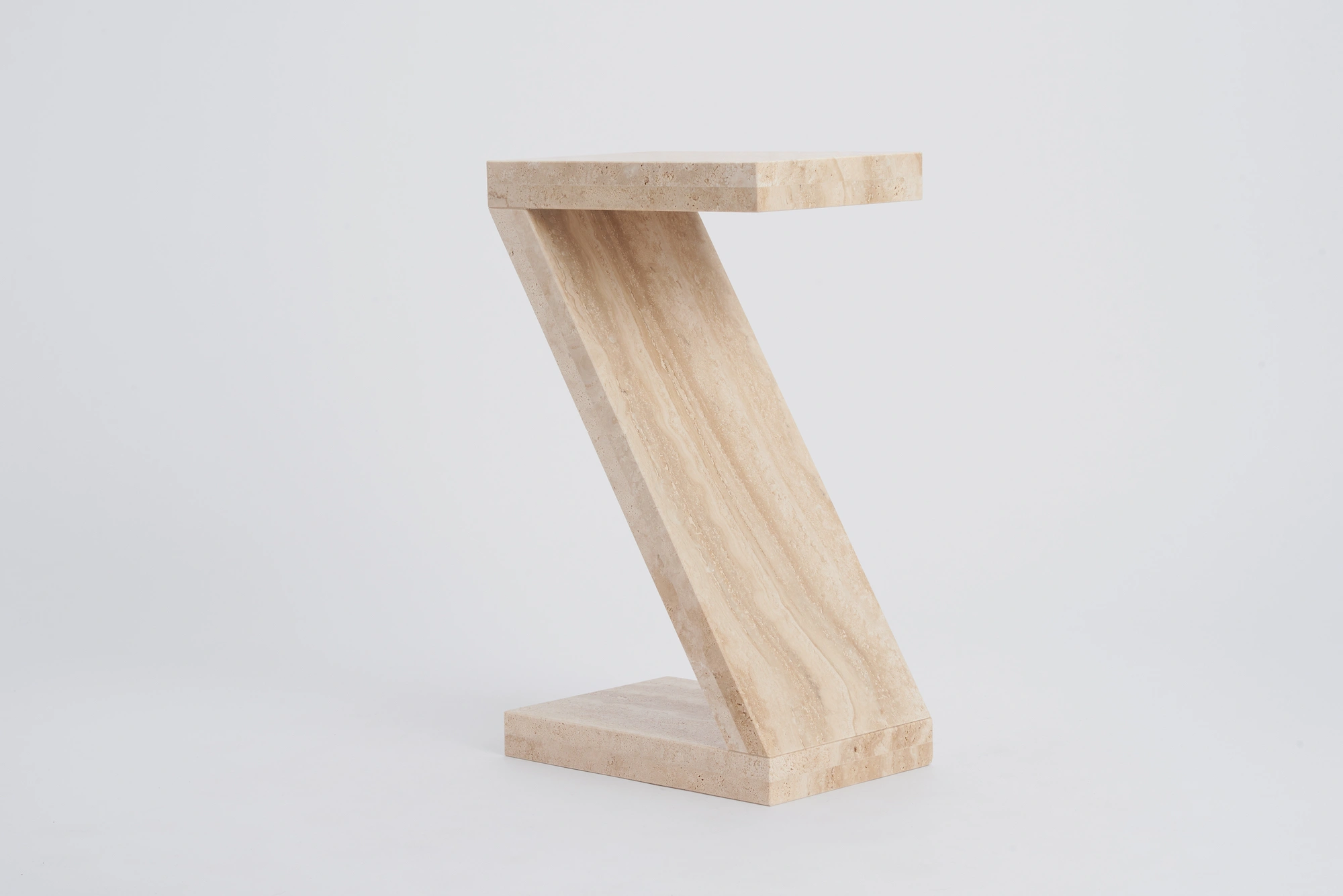
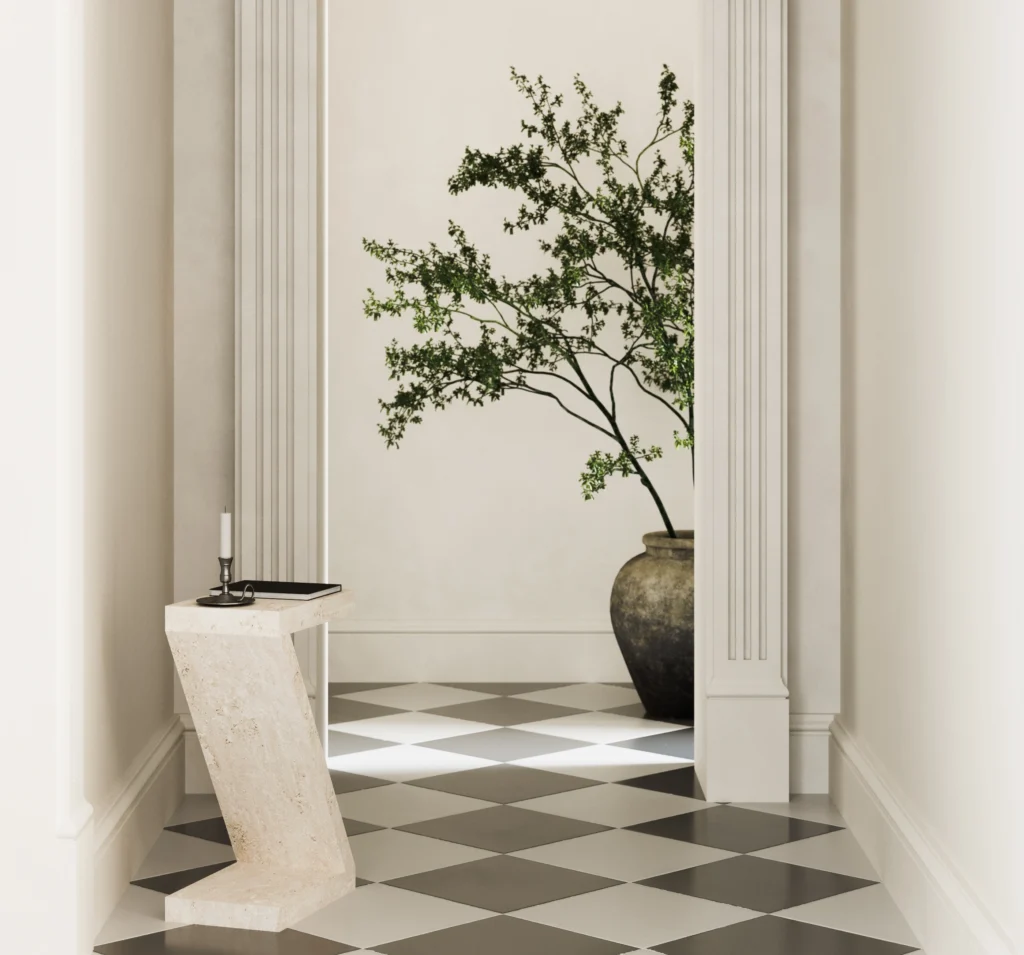
The Petra Madalena Travertine Side Table – sculptural form meets natural stone artistry.
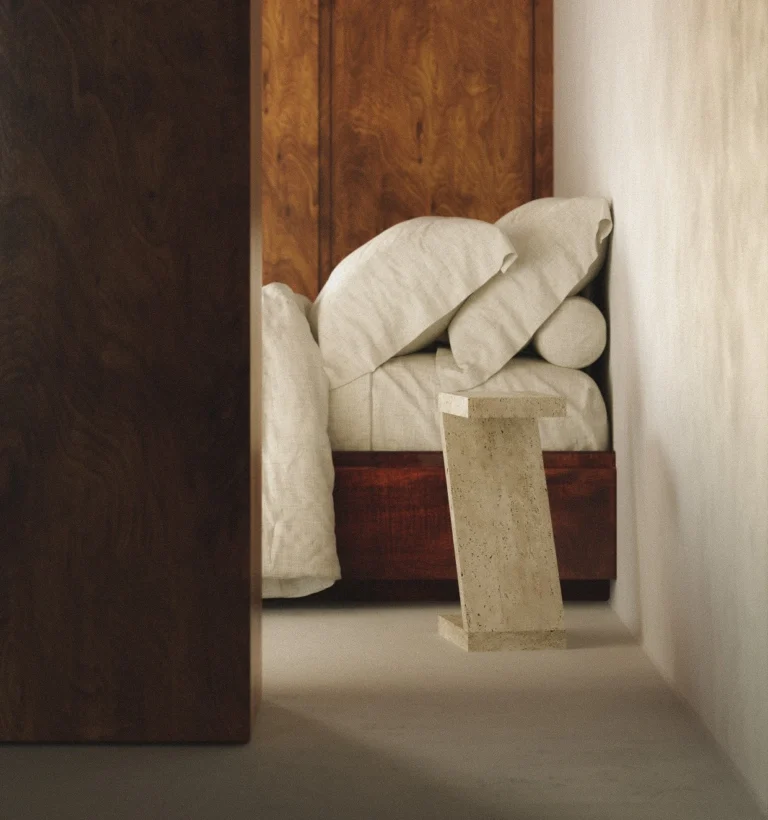
The Travertine Side Table is a study in what happens when design treats stone as a sculptural medium rather than a flat surface. The cantilevered Z-form creates an architectural silhouette that appears to defy the weight of the material – a diagonal line of warm, cream-toned travertine connecting a floating tabletop to a grounded base. The veining runs continuously through the entire structure, tracing the stone’s natural history from base to surface in a single unbroken flow.
What makes this piece remarkable is how the form amplifies the material. The angled plane catches light differently across its length, revealing the subtle shifts in tone and texture that make travertine so captivating. The natural pitting remains visible, adding depth and tactile character that a polished, machine-perfect surface would lose. Placed beside a sofa as a companion to a larger travertine coffee table, or standing alone as an accent piece, the side table holds its own as a sculptural object that happens to be functional.
This is what Petra Madalena‘s approach to furniture looks like in practice: a piece where the geometry serves the stone, the proportions feel resolved, and the result sits comfortably between furniture and art. Explore the Travertine Side Table in detail, or browse the full coffee table collection to see more examples of travertine crafted with this same philosophy.
A travertine coffee table is not just furniture – it is a sculptural centerpiece shaped by nature and refined by design. The stone’s organic texture, warm color palette, and one-of-a-kind surface patterns bring something to a modern living room that no factory-made alternative can match: a sense of permanence, artistry, and genuine material beauty that deepens with time.
Whether you are drawn to the serene calm of ivory travertine in a minimalist space, the grounded warmth of walnut tones in an earthy interior, or the raw drama of an unfilled sculptural slab, the right coffee table transforms the way a room feels the moment you walk in.
At Petra Madalena, every piece begins with the stone. Explore our coffee table collection to see how natural travertine becomes functional art – or reach out to discuss a custom piece designed specifically for your living room.
A travertine coffee table is a natural stone centerpiece that brings sculptural beauty and organic texture to modern living rooms. This guide explores what makes travertine unique as a furniture material, how to choose the right color and finish for your space, and why a custom-crafted stone table can transform the way an entire room feels.
Travertine works as a modern living room centerpiece because its organic texture, warm color spectrum, and one-of-a-kind surface patterns create a sculptural quality that no manufactured material can replicate. Every slab carries thousands of years of geological history in its veining and pitting – making each coffee table a genuine original. When custom-designed around the stone’s natural character, a travertine table becomes the visual anchor of the room: part functional surface, part art piece. For homeowners looking to move beyond mass-produced furniture and invest in something that holds its beauty for a lifetime, travertine offers a rare combination of warmth, permanence, and natural artistry.
Travertine stands out because it is a natural stone with a depth of character that engineered surfaces cannot replicate – its texture, color variation, and organic patterning make every piece visually unique.
Formed over thousands of years near hot springs and mineral-rich water sources, travertine is a dense, banded limestone that develops its signature veining, pitting, and layered color through the slow precipitation of calcium carbonate. The result is a surface with extraordinary visual depth. Unlike granite’s uniform speckle or marble’s flowing veins, travertine carries a more tactile, almost sculptural texture – especially when left unfilled, where the natural pitting creates subtle shadows and dimension that shift with the light throughout the day.
The natural color palette ranges from soft ivory and warm cream through golden honey tones to rich walnut and cool silver. These warm neutrals mean a travertine coffee table complements virtually any modern interior palette without competing for attention – it enhances a room rather than dominating it.
Travertine also carries a history of architectural prestige. The Romans built the Colosseum from it. The Getty Center in Los Angeles is clad in 16,000 tons of it. When this stone sits in your living room, it brings that same sense of solidity and timelessness – scaled down to something you can gather around every day. For a deeper look at how travertine compares to other premium natural stones, read our guide on travertine vs marble.
Yes – with the right finish and a simple sealing routine, a travertine coffee table is entirely practical for daily use in a busy modern living room.
The most common concern about natural stone furniture is durability, and it is worth addressing directly. Travertine is a porous material, which means it can absorb liquids if left untreated. A quality penetrating sealer solves this. Applied once or twice a year, it creates an invisible barrier that protects the stone from stains while preserving its natural look and feel. Most high-quality sealers take less than 30 minutes to apply and need no professional help.
Finish selection also plays a practical role. A honed (matte) and filled surface is the most forgiving option for a table for coffee that sees daily use – minor scratches blend into the matte texture, and the filled pores create a smoother surface that is easy to wipe down. Polished travertine offers a more refined, reflective look but shows fingerprints and water rings more readily. Unfilled and tumbled finishes embrace the stone’s raw character but require slightly more attention when cleaning.
One of the most compelling practical arguments for travertine is how it ages. Unlike engineered materials that degrade over time, natural stone develops a patina – a gentle softening of the surface that adds warmth and character with each passing year. A travertine coffee table in a family living room does not just survive daily life; it absorbs it gracefully and becomes more beautiful because of it.
A travertine coffee table becomes a centerpiece when the stone’s natural character leads the design – and when the piece is given the right scale, shape, and breathing room to command attention.
Scale is the starting point. A coffee table that is too small for the seating arrangement disappears; one that dominates the space feels heavy. The general principle is that the table should be roughly two-thirds the length of the sofa and sit at a height that allows comfortable reach from the surrounding seats. With a material as visually rich as travertine, getting the proportions right means the stone does the heavy lifting – no excessive styling required.
Shape adds another layer of personality. Geometric slabs with clean edges suit minimalist interiors where the texture provides the visual interest. Organic freeform shapes – where the table follows the stone’s natural contours – create a more sculptural, gallery-like presence. Monolithic block designs, where the base and surface are carved from a single mass, deliver maximum visual weight and anchor a room with quiet authority. Design experts note that sculptural furniture and statement stone are among the strongest trends carrying into 2026 – and these kinds of bold, organic forms are a defining feature of contemporary coffee table design.
Placement matters too. Leave enough open floor around the table so it can be appreciated from multiple angles. Avoid pushing it against the sofa – a little breathing room lets the stone’s texture catch light differently throughout the day. At Petra Madalena, every custom coffee table is designed around a specific slab’s character, ensuring the finished piece works as a sculptural focal point in the room it is built for.
The best travertine color and finish depends on the existing palette and mood of the room – there is no single right answer, but there are clear matches that work exceptionally well.
For light, airy minimalist living rooms with white or pale gray walls, ivory or cream travertine with a honed finish creates a soft, warm counterpoint that prevents the space from feeling sterile. In earthy modern interiors with warm wood tones and textured textiles, warm beige or walnut travertine deepens the organic feel and grounds the room. Cooler contemporary spaces with concrete, steel, or dark upholstery pair beautifully with silver-toned travertine, which introduces natural warmth without disrupting the cooler palette.
|
Color Tone |
Room Style Match |
Mood |
|
Ivory / Cream |
Light minimalist, Scandinavian, coastal |
Airy, serene, clean |
|
Warm Beige |
Earthy modern, transitional, Mediterranean |
Grounded, inviting, organic |
|
Walnut |
Rich contemporary, wabi-sabi, layered interiors |
Warm, intimate, dramatic |
|
Silver |
Cool modern, industrial-refined, urban loft |
Understated, sophisticated, calm |
|
Gold |
Luxe contemporary, warm maximalist, Art Deco-inspired |
Opulent, radiant, statement-making |
Finish has just as much impact as color. Here is how the main options compare for a travertine accent table or coffee table in a living room setting:
|
Finish |
Look & Feel |
Best For |
Maintenance |
|
Honed |
Smooth matte surface, soft to the touch |
Everyday living rooms, families with children |
Low – most forgiving finish |
|
Polished |
Glossy, reflective, highlights veining |
Formal living rooms, refined interiors |
Moderate – shows fingerprints and rings |
|
Tumbled |
Rounded edges, rustic texture, aged look |
Mediterranean, farmhouse, wabi-sabi spaces |
Moderate – textured surface traps dust |
|
Brushed |
Subtle texture, soft matte with slight grain |
Contemporary and transitional spaces |
Low to moderate |
|
Unfilled |
Raw natural pitting visible, dramatic shadows |
Gallery-style, sculptural, statement pieces |
Higher – pores require careful cleaning |
When selecting a slab for a custom coffee table, the advantage is that you can see the exact stone before committing – choosing the precise color, veining pattern, and finish combination that works for your specific room.
The most effective approach is to let the stone be the hero – style around it with restraint so the travertine’s natural beauty stays the focal point.
Start with what sits beneath and beside the table. A textured wool or jute rug underneath creates a soft contrast to the stone’s cool, solid surface and grounds the entire seating area. For upholstery, linen, bouclé, and velvet all work beautifully alongside travertine – the key is choosing fabrics with tactile character that complement the stone’s texture rather than competing with it. Neutral and earthy tones (cream, oatmeal, sage, clay) tend to harmonize naturally with travertine’s warm palette.
On the tabletop itself, less is more. A curated stack of two or three books, a ceramic vessel or sculptural object, and perhaps a candle or small tray is plenty. The goal is to create small moments of visual interest without obscuring the stone. Think of the travertine surface as a canvas – the veining and texture are already doing the design work, so anything placed on top should feel intentional and minimal.
What to avoid: overcrowding the surface with too many objects, using placemats or tablecloths that hide the stone entirely, or pairing the table with a visually loud rug that fights for attention. The travertine coffee table is the centerpiece – everything else in the arrangement should support it, not compete with it.
A custom travertine coffee table is designed around the unique character of a specific slab – mass-produced alternatives treat natural stone as interchangeable raw material, and the difference shows.
When a factory produces stone furniture at scale, every piece follows the same template. The slab is cut to a standard shape, paired with a generic base, and shipped with no regard for how its individual veining, color, or texture might be best presented. The result is furniture that happens to be made of stone, but does not celebrate the stone itself.
The custom approach reverses that process entirely. At Petra Madalena, the design begins with the slab. The stone’s natural veining pattern, color variations, and surface character inform every decision that follows – from the table’s shape and proportions to the base design and finish treatment. The goal is furniture that feels like a sculptural art piece, not just a surface to set things on.
|
Feature |
Mass-Produced |
Custom (Petra Madalena) |
|
Slab Selection |
Random allocation from inventory |
You see and approve the exact slab |
|
Shape Design |
Standard rectangle, oval, or circle |
Tailored to the stone’s natural character and your room |
|
Size Options |
Fixed catalog dimensions |
Built to your exact specifications |
|
Base / Legs |
Generic metal or wood frame |
Designed as part of the overall sculptural composition |
|
Uniqueness |
Identical to hundreds of other units |
One of a kind – no duplicate exists |
|
Long-term Value |
Depreciates like standard furniture |
Holds value as a handcrafted art piece |
A custom coffee table also means the piece is built for the specific room it will live in. Proportions are calibrated to the sofa, the ceiling height, and the overall spatial flow – so the table feels like it belongs rather than like it was ordered from a catalog. When the goal is furniture that doubles as art, custom design is the only path that delivers consistently.
This piece captures everything that makes travertine furniture extraordinary – sculptural form, natural material beauty, and a design philosophy where the stone leads.
The Petra Madalena Travertine Side Table – sculptural form meets natural stone artistry.
The Travertine Side Table is a study in what happens when design treats stone as a sculptural medium rather than a flat surface. The cantilevered Z-form creates an architectural silhouette that appears to defy the weight of the material – a diagonal line of warm, cream-toned travertine connecting a floating tabletop to a grounded base. The veining runs continuously through the entire structure, tracing the stone’s natural history from base to surface in a single unbroken flow.
What makes this piece remarkable is how the form amplifies the material. The angled plane catches light differently across its length, revealing the subtle shifts in tone and texture that make travertine so captivating. The natural pitting remains visible, adding depth and tactile character that a polished, machine-perfect surface would lose. Placed beside a sofa as a companion to a larger travertine coffee table, or standing alone as an accent piece, the side table holds its own as a sculptural object that happens to be functional.
This is what Petra Madalena‘s approach to furniture looks like in practice: a piece where the geometry serves the stone, the proportions feel resolved, and the result sits comfortably between furniture and art. Explore the Travertine Side Table in detail, or browse the full coffee table collection to see more examples of travertine crafted with this same philosophy.
A travertine coffee table is not just furniture – it is a sculptural centerpiece shaped by nature and refined by design. The stone’s organic texture, warm color palette, and one-of-a-kind surface patterns bring something to a modern living room that no factory-made alternative can match: a sense of permanence, artistry, and genuine material beauty that deepens with time.
Whether you are drawn to the serene calm of ivory travertine in a minimalist space, the grounded warmth of walnut tones in an earthy interior, or the raw drama of an unfilled sculptural slab, the right coffee table transforms the way a room feels the moment you walk in.
At Petra Madalena, every piece begins with the stone. Explore our coffee table collection to see how natural travertine becomes functional art – or reach out to discuss a custom piece designed specifically for your living room.